
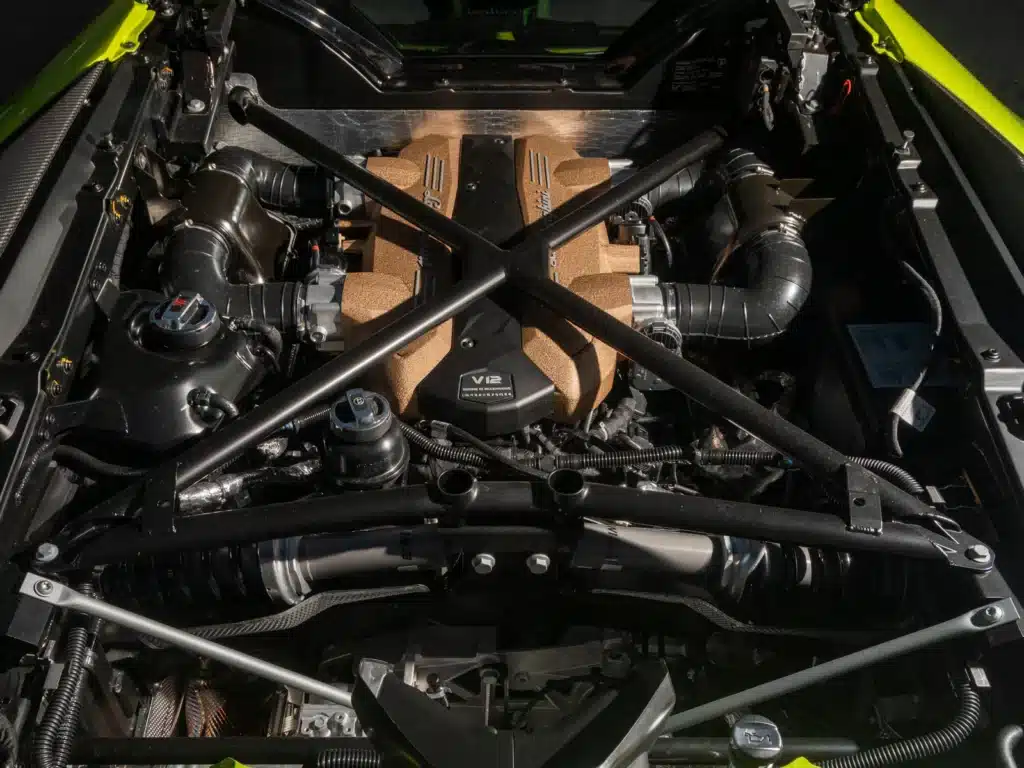
Ten exotic cars are appreciating in Q2 2026. Not holding value. Not depreciating slower than the segment. Growing invested capital, verified by trailing transaction data across public auction platforms, live auction houses, and aggregated market benchmarks. The question every serious acquirer should be asking is which appreciating exotic cars 2026 data confirms as net-positive after carrying costs, which survive the tax math, and which trade liquid enough to exit when the thesis is complete.
We ran every vehicle in our coverage universe through a proprietary scoring model. The results split cleanly into three tiers, and the pattern will surprise no one who has been watching the market since the Revuelto replaced the Aventador and the G580 replaced the V8 G-Wagen: the appreciating list is overwhelmingly composed of vehicles whose production lines are permanently closed, whose engines cannot be manufactured again, and whose mechanical character has no continuation path in the electrified successors that replaced them.
That pattern has a name. The market is calling it the internal combustion engine (ICE) premium.
In this article:
- Our Score Composition Explained
- What the Scoring Revealed
- Which Vehicles Made the Cut
- The Regulatory Cliff
- Value Strategies That Separate Smart Money from Retail
- Carrying Cost vs. Appreciation: The Real Math
- OBBBA: The Cap Below 6,000 Pounds
- The Counter-Example: Cayenne Turbo GT
- What the Appreciation List Reveals
- The Wind-Down of the Naturally Aspirated Phenomenon
- Frequently Asked Questions
Our Score Composition Explained
Each vehicle is evaluated across six composite dimensions for a maximum index of 60. Liquidity carries the heaviest weight because an asset you cannot exit is not an asset.
| Dimension | What It Measures |
|---|---|
| Dynamics | Powertrain significance, transmission type, engineering provenance, motorsport lineage |
| Liquidity | Manufacturer’s Suggested Retail Price (MSRP) multiples, auction sell-through rates, channel depth, exit velocity |
| Reliability | Documented failure modes, remediation cost, platform maturity, specialist network depth |
| Flexibility | Brand tier, variant breadth, body style options, specification market |
| Daily-ability | Livability as a regular-use vehicle: visibility, ride, conspicuousness, practicality |
| Rarity | Production volume, engine replaceability, platform terminal status |
What the Scoring Revealed
The model produced a verdict for each vehicle. Some are clean appreciation plays. Some carry exit caveats the acquirer needs to price in before writing a check. One is depreciating, and it is there to show what the pattern looks like when it breaks.
Continuing from our Smart Money analysis in February 2026, our scoring model evaluates each vehicle for a maximum index of 60. Each input is a composite and Liquidity is weighted heaviest because an asset you cannot exit is not an asset.
| Vehicle | Dyn | Liq | Rel | Flex | Daily | Rar | Verdict |
|---|---|---|---|---|---|---|---|
| 991.2 GT3 Touring | 10 | 10 | 9 | 7 | 8 | 6 | Appreciation tier |
| 991.2 GT3 Manual | 10 | 9 | 9 | 8 | 7 | 5 | Appreciation tier |
| Ferrari 812 Competizione | 9 | 8 | 6 | 9 | 5 | 8 | Appreciation tier (live auction) |
| McLaren 765LT Coupe | 10 | 7 | 6 | 9 | 4 | 9 | Appreciation tier (exit caveat) |
| Lamborghini Aventador SVJ Coupe | 8 | 9 | 5 | 10 | 2 | 9 | Appreciation tier |
| Ferrari 812 Superfast | 8 | 8 | 7 | 9 | 6 | 5 | Appreciation tier (V12 floor) |
| Aventador SVJ Roadster | 8 | 9 | 5 | 9 | 2 | 9 | Appreciation tier |
| Ford Shelby GT350R | 9 | 8 | 6 | 5 | 8 | 6 | Appreciation tier |
| Lamborghini Urus Performante | 6 | 8 | 7 | 8 | 9 | 4 | Appreciation tier (OBBBA-qualified) |
| Aventador Ultimae Roadster | 8 | 7 | 5 | 8 | 2 | 10 | Appreciation tier (exit caveat) |
| Cayenne Turbo GT | 6 | 4 | 8 | 7 | 10 | 2 | Depreciating (70-80% of MSRP) |
The Cayenne Turbo GT is here for one reason: to show what happens when a vehicle has the V8 credentials and the closed-line narrative but lacks the production scarcity to back it up. More on that later.
Data First: Which Vehicles Made the Cut
991.2 GT3 Touring | Score: 50/60
Dynamics at 10: naturally aspirated flat-six, manual-only transmission, Mezger-derived engineering significance as the last NA GT3 before the 992.2 hybrid. Liquidity at 10 is the highest on this list, driven by MSRP multiples exceeding 1.6x and a late 2025 record that cleared 3x base sticker. Reliability at 9 reflects the 991 platform’s decade of maturity and the deepest specialist network in the exotic segment; every documented issue (cam bolt, rear main seal, center lock hub) is sub-$4,000. Flexibility at 7 is the trade-off for purity: manual-only, single body style (wing-deleted only), no PDK option. Daily-ability at 8 benefits from the wing deletion, which reduces conspicuousness for daily use. Rarity at 6: approximately 1,800 to 2,150 global production (755 verified North American units: 722 US, 33 Canada), closed platform, electrification transition underway.
The Porsche 911 GT3 991.2 Touring scores highest in the matrix not because it appreciates fastest, but because it appreciates and trades. That combination is rarer than the headlines suggest.
The Touring trades at over 60% above its original sticker with a late 2025 record exceeding 3x the car’s base MSRP. A Paint to Sample Maritime Blue Touring sold through Collecting Cars in 2025 within that range. April 2026 data confirms the trend: a Touring cleared $283,000 against an approximate $170,000 sticker, a 166% retention rate.
The Touring’s Liquidity score of 10 is the only perfect Liquidity mark on this list. The asset appreciates, and you can exit it.
What separates the 991.2 from every other appreciating exotic car in 2026 is sell-through. The GT3 clears roughly 63% of its public auctions across all variants. The GT350R clears 82%. The Urus Performante clears 90%. By contrast, the 812 Superfast, which shares the F140 V12 with the Competizione, clears 58% and sits in a buyer’s market with 26 active listings. The 991.2 GT3 is the asset on this list where the spread between appreciation trajectory and exit velocity is most favorable.
Auction Sell-Through Rate (2025-2026 Year to Date (YTD))
Urus Performante
90%
Highest on this list
SVJ Coupe
88%
Strong demand signal
GT350R
82%
Consistent exit
Porsche is not accidentally undersupplying the market. The company’s sales leadership has stated the strategy explicitly.
“In 2026, we have a clear focus; we want to manage demand and supply according to our ‘value over volume’ strategy.”
Matthias Becker, Member of the Executive Board for Sales and Marketing, Porsche AG, January 2026
That discipline applies to the current lineup, but its secondary effect is felt most acutely on the 991.2 GT3. When the manufacturer restricts new supply, used supply of the predecessor generation absorbs the demand that the factory will not fill. The 991.2 is not just scarce because production ended. It is scarce because Porsche is deliberately constraining the successor’s availability.
The Mezger-derived 4.0-liter flat-six, the last naturally aspirated engine in the 911 GT lineup before the 992.2’s hybrid integration, produces 500 horsepower and a sound that stops conversations at 7,500 RPM and ends them entirely at 9,000. There is no turbo lag to fill, no electric motor whine to mask, no software smoothing the transition between intake roar and exhaust bark. It is mechanical anger, delivered without apology, through a throttle cable that translates your right foot into decibels with zero interpretation. The 992.1 GT3 was the successor; it scored 42 on the Silicon Scarcity Asset Matrix and trades at a modest premium to MSRP. The 991.2 is the generational predecessor, and the generational predecessor premium is doing exactly what the Smart Money analysis predicted: the older, purer car is pulling away.
991.2 GT3 Manual | Score: 48/60
Dynamics at 10 matches the Touring: same Mezger-derived flat-six, same manual transmission, same terminal-architecture significance. Liquidity at 9 reflects MSRP multiples around 1.4x with a cap below the Touring’s 10 because trailing sell-through samples are thinner and lack the Touring’s multi-platform confirmation at the top of the range. Reliability at 9 is identical: same 991 platform, same specialist depth, same sub-$4,000 issue ceiling. Flexibility at 8 is the Manual’s advantage over the Touring: access to both wing and Touring body styles plus a PDK option broadens the configuration market. Daily-ability at 7 drops one point from the Touring because the fixed rear wing adds visual conspicuousness. Rarity at 5: approximately 2,240 US-delivered manual units within roughly 9,500 total 991.2 GT3 production, held at 5 by the electrification transition thesis rather than raw scarcity.
The manual variant now commands roughly 40% above its original window sticker. The February 20, 2026 record sale at public auction cleared 2x MSRP for the first time, marking the moment the 991.2 Manual crossed from “strong resale” to “verified appreciation.” The two-point gap between the Manual (48) and the Touring (50) comes entirely from Liquidity and Rarity: the Touring’s lower production and stronger MSRP multiples widen the spread. Both share the same engine, the same platform maturity, and the same terminal thesis. For the acquirer who wants the wing and the broader configuration market, the Manual is the play. For the acquirer optimizing exit velocity, the Touring’s Liquidity 10 closes the argument.
The GT350R | Score: 42/60
Dynamics scores 9: the 5.2-liter flat-plane-crank Voodoo V8 at 8,250 RPM is naturally aspirated, manual-only, and the first flat-plane crank from a US manufacturer. No documented production-car lap records at GT3 or SVJ level prevent a 10. Liquidity at 8 reflects sell-through between 73% and 82% with MSRP multiples straddling the 1.0x to 1.35x range for standard cars and reaching 1.3x to 1.4x for collector-grade examples. Reliability at 6 carries the Voodoo engine’s known oil consumption issue, a potential $25,000+ engine replacement that drops the platform one point from its maturity-based score of 7. Flexibility at 5 is the lowest on this list: Ford’s brand tier sits below every European manufacturer in the framework, and a single body style with a single transmission offers no variant breadth. Daily-ability at 8 compensates: the Mustang platform delivers good sightlines, a practical trunk, and nationwide Ford dealer coverage. Rarity at 6 reflects 3,511 total units with scrapped tooling that makes the Voodoo engine irreplaceable at the component level.
At 8,250 RPM, the 5.2-liter flat-plane-crank Voodoo V8 sounds like nothing else Ford has ever built and nothing Ford will ever build again. The cross-plane crank that defines every other Mustang V8 produces a burble. The flat-plane crank produces a scream: higher-pitched, harder-edged, closer to a Ferrari 458 than a Boss 302. Ford built 3,511 GT350Rs between 2015 and 2020, each with a six-speed manual and nothing between the driver’s right foot and that engine except mechanical linkage.
Market data already classifies the GT350R as an emerging collectible. The 2015 first-year examples (just 37 built as R-spec cars) have appreciated over 60% from their 2018 baseline to current levels that approach 4x the car’s original MSRP.
GT350R Market Snapshot
Sell-Through
82%
2025-2026 YTD
Total Production
3,511
Tooling scrapped
Standard MSRP Multiple
1.0-1.35x
Collector grade higher
Public auction sell-through for the GT350R runs 82% across 2025 and 2026 YTD. Standard 2016 through 2018 cars with moderate mileage transact between the original MSRP and roughly 35% above it. Heritage Edition examples from the 2020 final year command premiums that put them in six-figure territory.
A critical correction for anyone following this market: the GT500 Heritage Edition referenced in several published data sets was a 2022-only commemorative trim, not a 2020 model. Verification against Ford’s production records confirms this. Any comp attributed to a “2020 Heritage Edition” is a data error.
The production tooling for the Voodoo engine was scrapped when the S550 Mustang ended. When the tooling goes, the engine is gone.
The GT350R sits in a price band that makes it the most accessible vehicle on this list. At roughly 1.3 to 1.4x MSRP for collector-grade standard examples, the entry cost is a fraction of the Aventador family. Ford’s current performance lineup runs turbocharged EcoBoost and supercharged Coyote V8s. Neither architecture shares a single component with the flat-plane crank. When the tooling goes, the engine is gone. That is the definition of terminal.
The 812 Competizione | Score: 45/60
Dynamics at 9: the F140 V12 at 9,500 RPM with 819 horsepower is the highest-revving road Ferrari ever built, but dual-clutch transmission (DCT)-only keeps it from 10. Liquidity at 8 carries real tension: MSRP multiples exceed 2.5x, yet three coupes listed at online auction in 2025 all failed reserve and transaction volume runs approximately 0.6 per month. The multiples say 10; the channel restriction says 7; the score splits the difference. Reliability at 6 reflects platform youth (2021 to 2022) and five-figure RWS actuator remediation, partially offset by the Ferrari service network. Flexibility at 9 benefits from the brand tier, the Coupe (999 units) plus Aperta (599 units) body split, and Tailor Made premiums reaching 20% to 35% above base specification. Daily-ability at 5 is the cost of track-focused calibration and PCV 3.0 steering complexity layered onto a front-engine GT chassis that would otherwise score 8. Rarity at 8: 1,598 total units, allocation-only at launch, terminal NA V12 with no continuation path.
The Ferrari 812 Competizione carries the strongest appreciation trajectory in the entire scoring framework. 999 units. The F140 6.5-liter naturally aspirated V12 revs to 9,500 RPM with 819 horsepower and a throttle response so immediate that the tachometer needle moves before your brain registers that your foot has moved. Ferrari’s last front-engine berlinetta V12 does not wind up to its power band. It detonates into it. The secondary market consistently reflects a sustained premium exceeding 2.5x original MSRP, with the Competizione A (Aperta) variant setting a new record at RM Sotheby’s Miami on February 27, 2026 that exceeded 3x sticker.
The Liquidity score is 8, driven by the sustained 2.5x+ MSRP multiples, but the channel tells an uncomfortable truth about the appreciating exotic car market. Three Competizione coupes listed at online auction in 2025. All three failed to meet reserve, with high bids ranging between approximately 2.5x and 2.9x MSRP. Those same cars would have cleared reserve at RM Sotheby’s or Bonhams without hesitation. The Competizione does not sell on the internet. It sells in a white-glove room where the buyer has a paddle number and the auctioneer knows them by name.
Three online auction failures at 2.5x to 2.9x MSRP. The same cars would have cleared at RM Sotheby’s. The channel, not the demand, is the constraint.
For acquirers with access to the live auction channel, the Competizione is the single strongest appreciation play on this list. For acquirers limited to online platforms, it is a magnificent asset that may not clear at the price it deserves. The channel, not the demand, is the constraint.
812 Superfast | Score: 43/60
Dynamics at 8: the same F140 6.5-liter naturally aspirated V12, same DCT, but without the Competizione’s PCV 3.0 steering or track-focused calibration. No additional engineering significance beyond the base NA score. Liquidity at 8 is driven by 100% BaT sell-through (4/4) and 79% all-platform clearance across 53 recorded sales, the strongest conversion rate of any V12 on this list. Reliability at 7 benefits from the 2017 to 2020 production window (6 to 9 years of field data) and the absence of the Competizione’s PCV 3.0 complexity. Flexibility at 9: Ferrari brand tier plus Coupe and GTS body variants. Daily-ability at 6 drops from the front-engine GT base of 8 for the 789 HP V12’s width and power demands. Rarity at 5: approximately 3,000 to 3,500 coupes, moderated by a platform total approaching 9,000 units, held at 5 by the terminal engine thesis.
The 812 Superfast is the Competizione’s higher-production sibling, trading at roughly MSRP with 26 active listings across dealer and aggregator channels. It is the V12 floor play: not the fastest appreciator on this list, but the one V12 that has completely defeated depreciation. High listing volume makes this a buyer’s market for acquirers targeting the F140 engine at the most accessible price point. If the Competizione is the penthouse, the Superfast is the lobby. Both share the F140 engine. One is an investment; the other is a position.
“The naturally-aspirated V12 is part of the history of the company and is certainly the heart of Ferrari. What we are doing is to try and identify ways to keep it alive.”
Enrico Galliera, Chief Marketing and Commercial Officer (CMO), Ferrari, May 2021
“The internal combustion engine has always been part of our DNA. We will continue to offer them across our product portfolio and bring innovations onto V6, V8, and V12 engines, by keeping on increasing the specific power.”
Ernesto Lasalandra, Chief Research and Development Officer (CRO), Ferrari, Capital Markets Day, October 2025
Aventador SVJ Coupe | Score: 43/60
Dynamics at 8: the L539 V12 at 770 horsepower starts at a naturally aspirated base of 8, the Nurburgring production car lap record adds 1, but the Independent Shifting Rod (ISR) single-clutch automated manual subtracts 1. Liquidity at 9 reflects MSRP multiples near 1.9x and 88% public auction sell-through, tempered only by channel dependency (live auction and dealer outperform online platforms by 20 to 30%). Reliability at 5 is the Aventador platform’s price: ISR actuator failures, E-Gear pump replacements, and front lift reservoir issues are documented and expensive. Flexibility at 10 is the highest on this list: Lamborghini’s brand tier combined with SVJ 63 (63 units), Ad Personam (348 factory colors), and color premiums reaching $30,000 to $50,000 above standard specification. Daily-ability at 2: ISR low-speed behavior, limited visibility, difficult maneuvering. Rarity at 9: 900 coupes, terminal L539 V12 with no continuation path.
900 coupes. The 6.5-liter naturally aspirated V12, Lamborghini’s L539 engine, producing 770 horsepower through an ISR single-clutch automated manual that every owner curses in traffic and worships at 8,500 RPM. At full throttle, the intake sits eighteen inches behind the driver’s head and the sound is not automotive. It is orchestral: twelve individual throttle bodies opening in sequence, each cylinder firing once per revolution, the harmonics building into a frequency that vibrates the sternum before it reaches the ears. No synthesizer replicates it. No hybrid successor attempts to.
The SVJ Coupe trades at nearly 1.9x its original MSRP. Auction sell-through runs 88% in the 2025 and 2026 window, but the spread between online auction clearance and live auction pricing remains wide: public platform bidders consistently close at 1.4 to 1.5x MSRP while the live auction and boutique dealer channels confirm 1.6 to 1.9x. The acquirer who sources through the right channel captures a 20-30% position advantage on the same asset. The SVJ owner who needs to exit has two channels that work: RM Sotheby’s (where the Monaco 2026 catalog includes a Blu Emera example) and the boutique dealer network where fixed-price listings move at the higher end of the range.
Aventador SVJ Roadster | Score: 42/60
Dynamics at 8 matches the Coupe: same L539 V12, same Nurburgring-record lineage, same ISR penalty. Liquidity at 9 is equally strong, with MSRP multiples exceeding 2x and roughly 34 recorded transactions per year across all platforms, averaging nearly three per month. Reliability at 5 mirrors the Coupe: identical Aventador platform, identical failure modes. Flexibility at 9 drops one point from the Coupe’s 10 because the Roadster is a single-configuration variant without the Coupe’s SVJ 63 or breadth of Ad Personam specification range. Daily-ability at 2: same ISR and visibility constraints as the Coupe, compounded by open-top weather dependency. Rarity at 9: 800 roadsters, terminal L539 V12.
The SVJ Roadster exceeds 2x its original MSRP, the highest sustained multiple in the Aventador family. Transaction volume runs deeper than the Coupe on a per-unit basis: 34 trailing-twelve-month sales across 800 total production is a 4.25% annual turnover rate, confirming that Roadster owners are not sitting on these cars indefinitely. The open-top premium that applies across every manufacturer on this list is at its most pronounced here. The exit path mirrors the Coupe: live auction and boutique dealer consignment outperform online platforms by a wide margin.
Aventador Ultimae Roadster | Score: 40/60
Dynamics at 8 matches the SVJ: same L539 V12 at its highest output (780 HP), same ISR, same naturally aspirated base. The Ultimae combines SVJ performance with Aventador S refinement but earns no additional Dynamics credit because the scoring framework rewards engineering firsts, not farewell editions. Liquidity at 7 reflects roughly 1.3x MSRP multiples on approximately twelve combined Coupe/Roadster transactions per year, with the exit running entirely through dealer and private treaty channels. Reliability at 5 mirrors the SVJ: identical Aventador platform, identical failure modes. Flexibility at 8 reflects the Lamborghini brand tier without variant breadth adjustment. Daily-ability at 2: same ISR and visibility challenges as the SVJ, compounded by open-top weather dependency. Rarity at 10 is the highest score on this list: 250 units, twice-closed production (original line closure, Felicity Ace restart, permanent re-closure), and absolute finality as the last Aventador ever built.
250 units. The Aventador Ultimae Roadster is not a variant of the SVJ. It is the final Aventador, built after Lamborghini closed the line, reopened it to replace the 15 units lost when the cargo ship Felicity Ace sank in the Atlantic in February 2022, and closed it again. The last Ultimae Roadster is the last of a twice-closed line, a distinction no other vehicle on this list carries.
The Felicity Ace sank 15 Ultimae units. Lamborghini reopened the line to replace them, then closed it permanently. Twice-closed production, absolute finality.
It trades at roughly 1.3x MSRP with approximately twelve transactions recorded in the trailing twelve months across the Ultimae Coupe and Roadster combined, averaging one per month. The exit path is dealer and private treaty: public auction volume is negligible for a vehicle this rare, and the acquirer pool operates through relationships, not platforms. Dealer asking prices range from 1.2x to 1.6x MSRP depending on specification and mileage.
The appreciation thesis is intact. The exit requires patience and the right channel. For the acquirer who understands that the last naturally aspirated V12 Lamborghini roadster ever built is worth the illiquidity, the Ultimae is a position that time will not dilute.
Urus Performante | Score: 42/60
The Performante’s 42 arrives through a dimensional profile unlike any sports car on this list. Dynamics at 6 applies the SUV Dynamics Coefficient: twin-turbo V8 base of 7, minus 1 for 5,291-pound curb weight and high center of gravity, plus 0.5 for 48V active anti-roll stabilization and rear-wheel steering, rounded down. Liquidity at 8 reflects roughly 1.2x MSRP multiples and 80% all-platform sell-through, tempered by 67+ active listings and tax-driven demand fragility that could evaporate if bonus depreciation rules change. Reliability at 7 carries three documented issues (high-pressure fuel pump (HPFP) fire risk recall, non-rebuildable ARS unit at $3,100 to $5,500, water pump) against the VW Group platform’s broad service infrastructure. Flexibility at 8 is the Lamborghini base with Ad Personam expanding the specification market. Daily-ability at 9 is the highest score in its class on this list: full SUV utility with all-weather capability, cargo, and passenger capacity. Rarity at 4 is where the Performante breaks from the appreciation pattern: the 4.0-liter twin-turbo V8 is shared across the Cayenne Turbo GT, Panamera, and Bentayga. The engine is producible. Only the Performante trim is discontinued.
The Urus Performante is the one vehicle on this list whose appreciation story is counterintuitive. It isn’t naturally aspirated. It isn’t a sports car. It is a twin-turbo V8 performance SUV that Lamborghini stopped building when the plug-in hybrid Urus SE took over the production line.
And it trades above its original sticker price on a closed production line.
A twin-turbo V8 SUV trading above sticker on a closed line. The Performante’s appreciation story is counterintuitive, and the tax math makes it more so.
The Classic.com Market Benchmark sits at roughly 1.2x MSRP. The record sale cleared nearly double MSRP in February 2026, though that is an outlier driven by an Ad Personam specification. The standard market clearing range sits comfortably above sticker for low-mileage, well-specified examples. Public auction sell-through runs 90% in the 2025 and 2026 window, and the 87 active dealer listings on Classic.com and 73 on Cars.com confirm the market is deep enough to trade.
The Performante’s real value proposition is the tax section that follows. At a confirmed Gross Vehicle Weight Rating (GVWR) exceeding 6,000 pounds, the Performante qualifies for full first-year bonus depreciation under the One Big Beautiful Bill Act (OBBBA). A business acquirer at the 37% bracket recovers roughly a third of the acquisition cost in Year 1 as a tax benefit, on an asset that is simultaneously trading above the price they paid. That combination exists nowhere else on this list except the Ferrari Purosangue and the Mercedes-AMG G63, and both of those are flat or declining in residual terms.
765LT Coupe | Score: 45/60
Dynamics at 10: the M840T twin-turbo V8 in longtail specification carries the lineage from F1 GTR to 675LT to 765LT, representing the last of its architecture before Artura hybridization. Track-focused weight reduction and aero credentials complete the ceiling score. Liquidity at 7 is the dimension that tempers the case: MSRP multiples run roughly 1.4x, but all-platform sell-through sits at 57% and zero public auction lots have appeared since July 2024. The exit has migrated entirely to dealer consignment and Collecting Cars. Reliability at 6 reflects platform youth (2020 to 2021) and a documented flywheel rattling issue requiring $10,000 to $16,800 in engine-out remediation, against McLaren’s position as the weakest brand for specialist support in the scoring framework. Flexibility at 9 benefits from Coupe (765 units) plus Spider (765 units, separate cap) and extreme visual presence. Daily-ability at 4 is the track-focused penalty: extreme ride, minimal ground clearance. Rarity at 9: 765 is 765. The production cap is binding.
The 765LT Coupe trades at roughly 1.4x its original MSRP with a 74% public auction sell-through rate. The Spider, with its own 765-unit production cap, runs even higher at 78% and clears between 1.3x and 1.4x MSRP.
McLaren owners with Coupes are splitting between public auction channels and dealer consignment, with asking prices consistently holding in the high-six-figure range. The Spider outperforms the Coupe on auction velocity, likely driven by open-top demand and the convertible premium that applies across every manufacturer on this list.
Zero public auction lots since July 2024. The 765LT’s exit has migrated entirely to dealer consignment and Collecting Cars.
McLaren’s brand weakness is real: the 720S depreciates, the Artura has collapsed, and the company’s Supply Priority score of 2 on the Silicon Scarcity Asset Matrix is the lowest of any manufacturer in the scoring framework’s coverage universe. The 765LT survives because 765 is 765. The production cap is binding, the twin-turbo 4.0-liter V8 longtail is the last of its architecture before the Artura hybridization, and the cap turned out to be McLaren’s single best strategic decision of the decade.
The Regulatory Cliff: Who Gets to Keep Building
Regulation (EU) 2024/1257, published May 8, 2024, sets the Euro 7 emissions framework. For mainstream manufacturers, new type approvals must comply by November 29, 2026. All new vehicles sold in the EU must comply by November 29, 2027. But Article 3(48) defines a “small-volume manufacturer” as one registering fewer than 10,000 passenger vehicles in the EU per calendar year, and Article 10(9) delays their compliance deadline to July 1, 2030. Ferrari registered 6,204 vehicles in Europe, Middle East, and Africa (EMEA) in 2024. Lamborghini registered 4,227. Aston Martin delivered 6,030 globally. McLaren shipped roughly 3,200. All four sit below the threshold. Porsche AG, at 310,718 deliveries and part of the Volkswagen connected group, does not.
“It could live forever without the laws coming. I don’t think we can handle Euro 7 without electrification or without turbos.”
Andreas Preuninger, Director GT Model Line, Porsche AG, Autocar, October 2024
2024 Deliveries vs. Euro 7 Small-Volume Threshold (10,000 EU units)
Ferrari (EMEA)
6,204
Qualifies
Lamborghini (EMEA)
4,227
Qualifies
Porsche AG
310,718
Does not qualify
The derogation extends the production window for engines still on the line. Ferrari’s F140 V12 powers the 12Cilindri today and can legally continue in Europe until mid-2030 under the small-volume exemption. Emanuele Carando, Ferrari’s Director of Product Marketing, confirmed the position at the 12Cilindri launch: the company will keep producing naturally aspirated V12s until the law no longer allows it. Aston Martin CEO Adrian Hallmark told Drive in February 2025 that the V12 has “until 2028 if nothing changes,” but noted that low-volume import derogations in both the EU and the US could extend that window. For acquirers evaluating assets in the current market, the derogation establishes a second wave of terminal engines: the V12s and high-revving naturally aspirated architectures still in production today will face their own regulatory closure between 2028 and 2030.
Every engine on this scoring list is already permanently closed. The 991.2 flat-six ended production in 2019. The L539 V12 ended in 2022. The Voodoo V8 ended in 2020. No derogation resurrects a closed line. The vehicles in this article are past the regulatory clock. They are the finished product of it.
Value Strategies That Separate Smart Money from Retail
Mileage Flattening: When the Odometer Stops Mattering
The traditional exotic car pricing curve penalizes every mile. A 30,000-mile 812 Superfast trades at roughly 45% below a delivery-mile example. That is the classic curve, and it applies to every vehicle on this list with uncapped production.
On the production-capped cars, something different is happening.
When only 999 examples exist and no more can be manufactured, a car with 15,000 miles is not materially less scarce than one with 1,500.
The discount between a sub-5,000-mile 812 Competizione and a 15,000-mile example is approximately 6 to 8%. On the Aventador Ultimae Coupe, the spread compresses to roughly 10%. On the SVJ Roadster, sub-12%. The market is pricing the engine and the serial number, not the odometer. When only 999 examples exist and no more can be manufactured, a car with 15,000 miles on it is not materially less scarce than one with 1,500.
We define the mileage flattening threshold at 12% low-to-mid discount. Below that line, the mileage curve has functionally collapsed. Above it, the traditional pricing model still applies.
Three vehicles fall definitively below: the 812 Competizione Coupe (6 to 8%), the SVJ Roadster (10 to 12%), and the Aventador Ultimae Coupe (9 to 10%). The practical implication for acquirers: a mid-mileage example of a production-capped appreciating exotic is the highest risk-adjusted entry point in the market. You pay 10% less. You lose nothing on exit.
The GT350R, despite its 3,511-unit production run, does not exhibit mileage flattening. The spread between a delivery-mile car and a 15,000-mile car exceeds 30%. Production volume matters. Scarcity drives flattening. Volume preserves the curve.
Generational Arbitrage: The Predecessor Premium
The 991.2 GT3 Manual trades at 1.39x MSRP. The 992.1 GT3 Manual trades at roughly 1.0 to 1.1x. The older car costs more than the newer car. That spread is the generational predecessor premium, and it exists because the 991.2 is the last GT3 generation before the hybrid 992.2 arrived.
The same dynamic plays out across the Aventador family. The SVJ (2018 to 2019 production) now trades above the Ultimae (2021 to 2022), which is the chronologically newer and technically superior car. The SVJ’s Nurburgring lap record, its Aerodinamica Lamborghini Attiva (ALA) active aero system, and its motorsport-derived character carry a premium that the Ultimae’s “farewell edition” positioning has not yet matched.
The older car costs more than the newer car. That is the generational predecessor premium.
Whether the Ultimae overtakes the SVJ in the secondary market is the single biggest open question in the V12 Lamborghini market as of Q2 2026. Current dealer asking prices for the Ultimae Roadster are converging with SVJ Roadster asks in several markets. If that crossover completes, it will mark the first time a “final edition” commanded more than the “track weapon” in the Aventador hierarchy.
Carrying Cost vs. Appreciation: The Real Math
An exotic car appreciating 8% annually with 4% carrying cost yields a 4% net return. An exotic car appreciating 3% with 5% carrying cost is a net loss the owner pays for the privilege of watching the odometer age. The carrying cost table is where every “best cars to buy” listicle collapses, because none of them run the math.
| Vehicle | Annual Carry (est.) | YTD Appreciation | Net |
|---|---|---|---|
| 991.2 GT3 Touring | ~$8,000 | +5 to 7% | Positive |
| GT350R (collector grade) | ~$5,500 | +5 to 10% | Positive |
| 812 Competizione | ~$15,000 | +2 to 5% | Positive |
| SVJ Coupe | ~$15,000 | +3 to 5% | Marginal positive |
| SVJ Roadster | ~$16,000 | +3 to 5% | Marginal positive |
| 765LT Coupe | ~$13,000 | +2 to 4% | Breakeven |
| Urus Performante | ~$10,000 | +2 to 3% (above MSRP) | Tax shield dominates |
| Ultimae Roadster | ~$14,000 | +2 to 4% | Breakeven |
Annual carrying cost breaks down into five categories, and the spread within each one is where the real ownership math lives.
- Insurance (agreed-value): $3,000 to $8,000/year
- Climate-controlled storage: $6,000 to $12,000/year
- Scheduled maintenance: $2,500 to $10,000/year
- Tire replacement (Cup 2 / Trofeo R): $2,500 to $4,500/set, prorated
Annual Registration on a $500,000 Exotic
Florida
$155
Flat fee
Montana LLC
$0
Now a liability
California
$19,500+
Vehicle License Fee
That registration line is not a typo. A vehicle valued above $500,000 in California incurs a Vehicle License Fee that exceeds the annual insurance premium in Florida. The state you title in is itself a financial decision, and it is the single largest variable in the carrying cost equation for vehicles at this price point. (For the registration arbitrage strategies that owners are using, and the ones that recently became liabilities, see our Montana LLC analysis.)
The vehicles that clear carry: the 991.2 GT3 Touring, the GT350R, and the 812 Competizione. The vehicles that break even or slightly exceed: the SVJ family and the 765LT. The vehicle where the tax shield matters more than the appreciation: the Urus Performante. For a business acquirer in the 37% bracket, the Performante’s full Year 1 deduction generates a cash tax benefit that dwarfs the carrying cost and any near-term price movement.
OBBBA: The Cap Below 6,000 Pounds
The One Big Beautiful Bill Act (signed July 4, 2025) permanently restored 100% bonus depreciation for qualifying business property. Every headline called it the exotic car write-off. The headlines were half right.
Bonus Depreciation Rate by Year (§168(k))
2022
100%
Tax Cuts and Jobs Act (TCJA) original
2023
80%
Phasedown
2024
60%
Phasedown
Jan 20, 2025+
100%
OBBBA (permanent)
Between 2023 and early 2025, the benefit of the Year 1 write-off on exotic or luxury vehicles above 6,000 pounds was not available. Bonus depreciation had phased down under the Tax Cuts and Jobs Act (TCJA) sunset schedule. A $133,000 heavy SUV fully expensed in September 2022 would have yielded roughly $92,000 in Year 1 deductions if the same owner tried in 2024. OBBBA closed that gap on January 20, 2025, restoring permanent 100% bonus depreciation under §168(k) for qualifying property acquired and placed in service after that date.
First-Year Expensing: The 6,000-Pound Threshold
The vehicle’s Gross Vehicle Weight Rating (GVWR), the manufacturer’s certified maximum loaded weight stamped on the driver’s door-jamb label, determines whether the full acquisition cost is deductible in Year 1. Above 6,000 pounds, Section 179 and §168(k) bonus depreciation combine to expense the entire purchase price. Below 6,000 pounds, §280F caps the deduction regardless of what the vehicle costs.
| Vehicle | MSRP (approx.) | GVWR | Year 1 Deduction | Tax Benefit (37%) | Years to Full Deduction |
|---|---|---|---|---|---|
| Above 6,000 lbs: Full First-Year Expensing | |||||
| Urus Performante | $260,000 | ~6,500 lbs | $260,000 | $96,200 | 1 |
| Mercedes-AMG G63 | $200,000 | ~7,000 lbs | $200,000 | $74,000 | 1 |
| Ferrari Purosangue | $400,000 | 7,253 lbs | $400,000 | $148,000 | 1 |
| Below 6,000 lbs: §280F Caps Apply | |||||
| 812 Competizione | $600,000 | ~3,500 lbs | $20,200 | $7,474 | 84+ |
| Aventador SVJ Coupe | $517,000 | ~3,900 lbs | $20,200 | $7,474 | 72+ |
| 765LT Coupe | $358,000 | ~2,950 lbs | $20,200 | $7,474 | 49+ |
| 991.2 GT3 Touring | $170,000 | ~3,400 lbs | $20,200 | $7,474 | 22+ |
| Ford Shelby GT350R | $73,000 | ~3,700 lbs | $20,200 | $7,474 | 9+ |
Years to full deduction: Year 1 ($20,200) + Year 2 ($19,600) + Year 3 ($11,800) + remaining balance at $7,060/year. Assumes qualified business use exceeding 50%. OBBBA did not change §280F.
One condition the write-off headlines never mention: if business use drops to 50% or below during the five-year Modified Accelerated Cost Recovery System (MACRS) recovery period, §280F(b)(2) requires the owner to include the excess depreciation as ordinary income. The acquirer who fully expenses a $300,000 Urus and converts it to weekend use in Year 3 has a six-figure recapture event.
The Capital Gains Sell Side: Managing the Win
For sub-6,000-pound sports cars where the financial story is appreciation, the tax conversation isn’t “how do I deduct the purchase?” It is “how do I manage the gain when I sell?”
Section 1031 like-kind exchanges are dead for vehicles. Many exotic car owners still believe they can roll one car into another tax-free. They can’t. Search the top ten results for “exotic car 1031 exchange” and you will find blogs from 2016 that haven’t been updated.
Like-kind exchanges under Section 1031 are limited to real property only. Personal property, including vehicles, is permanently excluded.
Tax Cuts and Jobs Act of 2017, 26 U.S.C. §1031(a)(1)
What remains: Opportunity Zone fund deferral (now permanent under OBBBA, with rolling five-year deferral and a 10% basis step-up at year five), installment sales to spread the gain across multiple tax years, charitable donation at fair market value for vehicles with low basis and high current value, loss harvesting to offset gains with losses from other positions, and the simplest strategy of all: hold until death. The stepped-up basis at death eliminates the capital gain entirely, resetting the heir’s cost basis to fair market value at the date of death. For the owner building a collection that will transfer generationally, this is not morbid tax planning. It is the most efficient exit in the code. (For the mechanics of selling an inherited exotic car, including probate, cross-state titles, and valuation documentation, see our guide for executors and heirs. For the full OBBBA playbook including LLC entity structures and sales tax credits, see our 2026 tax strategy analysis.)
This is general framework only, not personalized tax advice. Consult a qualified tax professional before structuring any vehicle acquisition for business use or capital gains management. The strategies above are options to discuss with your advisor, not recommendations to execute without professional guidance.
The Counter-Example: Cayenne Turbo GT | Score: 37/60
The Cayenne Turbo GT scores 37, the only vehicle below the appreciation threshold. Dynamics at 6 applies the SUV Dynamics Coefficient: twin-turbo V8 base of 7, minus 1 for 5,120-pound curb weight, plus 0.5 for Porsche Dynamic Chassis Control (PDCC) active anti-roll and adaptive air suspension, rounded down. Liquidity at 4 defines the verdict: three verified auction transactions show retention between 68.8% and 80.5% of as-configured window sticker, with each sequential data point lower than the last. Reliability at 8 is the strongest dimension, reflecting a mature Porsche SUV platform with no documented catastrophic failure modes and the broadest service network in the segment. Flexibility at 7 drops one point from the Porsche base for single-configuration range. Daily-ability at 10 is the highest score on this list: a Porsche SUV with full passenger, cargo, and all-weather capability. Rarity at 2 is the lowest: the 4.0-liter twin-turbo V8 is shared with the Cayenne Turbo, Panamera, and other VW Group products. The engine is producible. Only the trim level is discontinued. That distinction is what separates 37 from 42.
The Porsche Cayenne Turbo GT has a twin-turbo V8. Porsche stopped making it. The successor is electrified. It checks every box on the “closed-line ICE” checklist.
Cayenne Turbo GT: Auction Results (2025-2026)
2025 MY (2,600 mi)
~80%
of as-configured sticker
2023 MY (low mi)
~70.5%
of as-configured sticker
2024 MY (<10K mi)
~69%
of as-configured sticker
The direction is consistent: down. Each sequential data point is lower than the last.
Three data points, three declines. The Cayenne Turbo GT is not stabilizing. It is forming a floor between 70% and 80% of sticker.
The 2024 model year’s GVWR dropped to 5,908 pounds, falling below the 6,000-pound threshold and eliminating full Year 1 expensing. The 2023 model year (GVWR 6,096 pounds) still qualifies, which means an acquirer choosing between two identical-looking Cayenne Turbo GTs, one a 2023 and one a 2024, faces a Year 1 deduction gap of approximately $180,000 based on nothing more than 188 pounds of curb weight.
“We will continue to produce ICE and PHEV [plug-in hybrid electric vehicle] versions of the Panamera and Cayenne well into the 2030s.”
Oliver Blume, CEO, Volkswagen Group (former CEO, Porsche AG), January 2026
That single sentence explains the depreciation. Winkelmann confirmed the Aventador V12 is gone. Galliera confirmed Ferrari is trying to keep its V12 alive. Blume confirmed Porsche will keep building ICE Cayennes. The market is pricing accordingly: the engines that are terminal appreciate. The engines that are continuing depreciate. The Turbo GT’s twin-turbo V8 is not scarce. Its trim level is.
What the Cayenne teaches: closed production line plus V8 does not guarantee appreciation. The GT350R has 3,511 units and appreciates. The Cayenne Turbo GT has comparable volume within its production years and depreciates. The difference is the Voodoo engine’s irreplaceability. Ford cannot build another flat-plane-crank V8 Mustang with a six-speed manual; the GT350R’s specific combination of engine, transmission, and chassis tuning is gone. Porsche can, and does, build turbocharged V8 Cayennes. The Turbo GT’s powertrain is not unique. Its production status is.
What the Appreciation List Reveals
Eight of the ten vehicles in the appreciation tier share three characteristics: a closed production line, an internal combustion engine as the sole power source, and no electrified successor that preserves the same mechanical configuration. The two turbo exceptions (765LT, Urus Performante) survive on binding production caps and the absence of a same-architecture continuation model.
Naturally aspirated engines dominate the top of the scoring matrix. The 812 Competizione’s V12 at 9,500 RPM, the SVJ’s V12 at 8,500 RPM, the GT350R’s Voodoo V8 at 8,250 RPM, the 991.2 GT3’s flat-six at 9,000 RPM: these are acoustic signatures that the hybrid and electric successors cannot reproduce and that the manufacturers have confirmed they will not attempt to reproduce. The sound is not a nostalgia argument. It is a scarcity signal. When the engine note cannot be manufactured, the engine itself becomes the asset.
“The Aventador LP 780-4 denotes the last, purest and eternal naturally aspirated Lamborghini V12. It is the definitive Aventador that brings an extraordinary era to a close.”
Stephan Winkelmann, President and CEO, Automobili Lamborghini, July 2021
The broader collector market is flat. Supercars are the outlier. The concentration of demand is consistent with every vehicle on this list, but it is not a generalizable signal: the premium accrues to the closed-line, mechanically sovereign cars, not to the segment as a whole.
The Wind-Down of the Naturally Aspirated Phenomenon
The GT350R’s Voodoo V8 program closed in 2020. The Aventador’s L539 V12 line was dismantled in 2022. Porsche’s naturally aspirated 4.0-liter flat-six is the last engine on this list still in production, but EU Euro 7 type-approval for new vehicle types begins November 29, 2026, with full compliance required for all new registrations by November 29, 2027.
“In America, I don’t know. Quite some time, maybe. In Europe, probably only a few years without any substantial changes.”
Andreas Preuninger, Director GT Model Line, Porsche AG, Car and Driver, April 2026
| Engine Program | Status (May 2026) |
|---|---|
| Ford Voodoo V8 (GT350R) | Program closed, 2020 |
| Lamborghini L539 V12 (Aventador) | Line dismantled, 2022 |
| Porsche 4.0L NA flat-six (992.2 GT3) | In production; Euro 7 deadline Nov 2027 |
| 992.2 GT3 RS successor | Turbo prototype confirmed, Nürburgring 2026 |
| US EPA barrier to NA GT3 | None currently |
| Euro 7 impact on used cars | None; resale and operation unaffected |
No EPA regulation currently requires Porsche to abandon the naturally aspirated flat-six in the US. That window is policy-dependent, not permanent; a single EPA rulemaking or California Air Resources Board (CARB) revision could close it. Car and Driver’s own analysis of Preuninger’s comments concluded that maintaining separate naturally aspirated and turbocharged powertrain programs for a low-volume sports car is economically prohibitive. Turbo GT3 RS prototypes have been confirmed at the Nürburgring with audible turbocharger spool, and multiple outlets report the successor will use a turbocharged flat-six globally. Between November 2026 and November 2027, EU dealers can sell remaining naturally aspirated GT3 inventory produced under existing Euro 6 type-approval; after that deadline, new non-compliant cars cannot be registered in Europe. The used market is unaffected: Euro 7 applies to new vehicle manufacturing only, and every car on this list can be bought, sold, and driven indefinitely.
Every quarter that passes, the surviving examples absorb another season of track days, another set of tires, another owner who adds miles or subtracts one car from the available supply through attrition, accident, or the decision to never sell. The pool does not refill. It contracts. And the acquirers who understand that are not waiting for Monterey Car Week to confirm what the Q1 data already shows.
The entity building what comes next is Horse Powertrain, a Renault/Geely joint venture headquartered in Hangzhou, targeting five million ICE and hybrid powertrains per year for Volvo, Nissan, Mitsubishi, and four other OEMs. The future of the internal combustion engine is being engineered in China. The GT350R’s Voodoo V8 was engineered in Flat Rock. The Aventador’s L539 V12 was assembled by hand in Sant’Agata. The 991.2 GT3’s flat-six was built in Stuttgart-Zuffenhausen. That is the difference between an engine that is institutional and an engine that is an asset.
Three forces built the ICE premium. Mechanical scarcity: the engines on this list are either closed or counting down to a regulatory deadline their own engineers say they cannot survive. Regulatory asymmetry: Euro 7 stops new supply in Europe by November 2027 but does not restrict a single car already built. Fiscal architecture: OBBBA’s permanent 100% bonus depreciation turns qualifying acquisitions into first-year write-offs above 6,000 pounds, while the appreciating lightweights compound capital below the 280F cap. The acquirers reading the data before Monterey Car Week reprices it will own the returns.
Frequently Asked Questions
Which exotic cars are appreciating in 2026?
Based on transaction-verified data through Q2 2026, the vehicles with the strongest appreciation trajectories are the Porsche 911 GT3 991.2 (Manual and Touring variants), the Ford Shelby GT350R, the Ferrari 812 Competizione, the Ferrari 812 Superfast, the Lamborghini Aventador SVJ (Coupe and Roadster), the Lamborghini Urus Performante, the McLaren 765LT Coupe, and the Lamborghini Aventador Ultimae Roadster. All share closed production lines and powertrain architectures with no continuation path.
What is the ICE premium?
The ICE premium is the measurable price appreciation commanded by exotic vehicles with internal combustion engines whose production lines have permanently closed and whose mechanical character has no electrified successor. It is a finding from transaction data, not a thesis imposed on the market.
Can I write off an exotic car under OBBBA?
For vehicles with a GVWR exceeding 6,000 pounds (G63, Urus Performante, Purosangue) used more than 50% for qualified business purposes, OBBBA’s permanent 100% bonus depreciation allows full first-year expensing. For vehicles under 6,000 pounds (GT3, SVJ, GT350R, 765LT, 812 Competizione), Section 280F caps limit the Year 1 deduction to $20,200 regardless of purchase price. The distinction is weight class, not vehicle type.
Why doesn’t the Cayenne Turbo GT appreciate despite being a discontinued V8?
Production scarcity alone does not drive appreciation. The Cayenne Turbo GT’s turbocharged V8 powertrain exists in other Porsche models. Its engine is producible; only its trim level is discontinued. By contrast, the GT350R’s flat-plane Voodoo V8 and the Aventador’s L539 V12 exist in no other vehicle. Engine-level irreplaceability, not production-line closure, is the sufficient condition.
Is 1031 like-kind exchange still available for exotic cars?
No. The Tax Cuts and Jobs Act of 2017 limited Section 1031 exchanges to real property only. This change is permanent and was not reversed by OBBBA. Strategies for managing capital gains on appreciating exotic cars include Opportunity Zone fund deferral, installment sales, charitable donation, loss harvesting, and stepped-up basis at death.
Exotics Wanted acquires high-end exotic and luxury vehicles directly from private owners, backed by real-time market intelligence and certified funds. Learn more about our process
Exotics Wanted, LLC is a vehicle acquisition company, not a law firm, CPA practice, financial advisory firm, or insurance brokerage. Nothing in this article constitutes legal, tax, financial, investment, or insurance advice. All market data, production numbers, auction results, and industry metrics are derived from publicly available sources believed to be accurate as of publication and are subject to change; forward-looking statements are projections based on current data and actual conditions may differ materially. This content does not constitute a recommendation to buy, sell, or hold any vehicle or asset; readers should consult a qualified professional in their jurisdiction before making transactional decisions. Analytical frameworks and scoring methodologies referenced in this article are proprietary to Exotics Wanted.
