
Sell Your Ferrari Roma
FAST. SECURE. NATIONWIDE. EXOTICS WANTED

Start Your Valuation
"*" indicates required fields
Home » Sell Your Exotic Car » Ferrari » Roma
The Legacy
Selling a Ferrari Roma
At Exotics Wanted, we understand that parting with your Ferrari Roma is a significant decision. With more than a decade in the high-performance vehicle market, our team recognizes what makes each model, generation, and specification unique.
Our valuations for the Ferrari Roma reflect what makes each example distinct. A twin-turbo V8 grand tourer with understated elegance, the Roma carries a market outcome shaped by how it was specified, maintained, and documented. We consider it one of the most compelling entry points in Ferrari's modern portfolio. Whether you own a Coupe or a Spider, every vehicle is reviewed individually. Our 2026 tax strategy analysis and Montana LLC enforcement guide address the surrounding complexity.
Our team personally manages every element of the transaction: title transfer, lien resolution, certified payment, and nationwide enclosed transport through our Bespoke Logistics division.
How It works

Tell Us About Your Exotic
Enter your VIN to auto-populate year, make, and model. Or start manually. Upload photos and note any modifications.

Market-Backed Proposal
A dedicated buyer reviews your vehicle against proprietary data and delivers a firm proposal, typically within one business day.

We Come to You
Enclosed Liftgate transport, licensed, bonded, and insured. Scheduled nationwide at your convenience.

Certified Funds & Fast Settlement
Once title clears, certified payment releases promptly. Clean-title vehicles often settle within 24 hours.

The Marque
The Ferrari Roma
Selling a Ferrari Roma is not a generic transaction. Outcomes vary meaningfully by configuration, condition, service history, and how a specific example is positioned within a market shaped by generation timing and successor dynamics.
When evaluating a Ferrari Roma, we focus on the factors that materially influence its market standing. Vehicle condition, service records, mileage context, original specification, and overall presentation are assessed together, not in isolation. Each car is reviewed individually, with attention to the details that distinguish one example from another and affect how it should be valued.
With an estimated 3,500 to 4,500 coupes produced globally and approximately 150 to 200 currently listed in the US, the Roma's value profile carries complexity that only surfaces under forensic examination: electronic architecture sensitivity, a successor that already corrects its most criticized feature, and a warranty structure that creates distinct pricing tiers based on coverage status. Below, we have classified Ferrari Roma variants by market profile and published our current market overview for this model.
The Variants
Ferrari Roma Variants We Actively Purchase
Exotics Wanted actively purchases well-presented Ferrari Roma examples from private owners nationwide. Each vehicle is reviewed individually on condition, specification, service continuity, and presentation. The Roma occupies a distinctive position within Ferrari's modern lineup: a twin-turbo V8 grand tourer that Ferrari projected would attract 70% first-time buyers during its production run, creating one of the most active secondary markets in the current Ferrari portfolio. Submissions outside the profiles listed below are evaluated on their own merits.
- Ferrari Roma Coupe (F169, 2020–2024): High-Velocity Asset Ferrari's entry-level front-engine grand tourer, powered by the 612 hp F154CD twin-turbo V8 paired with an 8-speed dual-clutch transaxle. An estimated 3,500 to 4,500 units were produced globally before the order books closed in early 2024, making this a high-liquidity asset with broad buyer demand. Valuation is optimized when the vehicle carries desirable factory options (carbon fiber exterior package, Daytona seats, front-axle lift, premium paint), complete authorized dealer service history, and low mileage, as mileage sensitivity is particularly acute for this model within the first 10,000 miles.
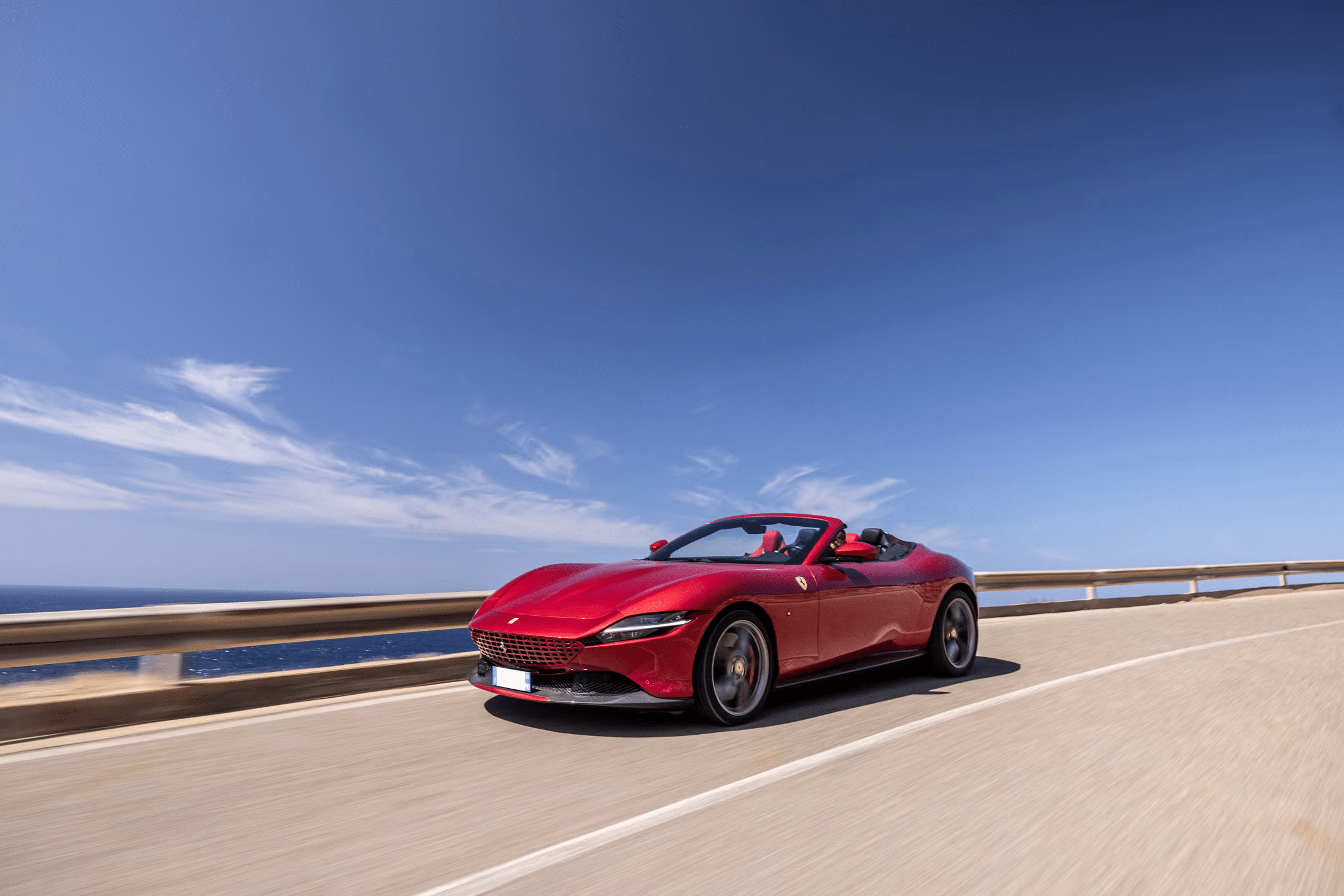
- Ferrari Roma Spider (F169S, 2023–present): High-Velocity Asset The open-top derivative featuring Ferrari's first fabric soft top on a front-engine model since the 1969 365 GTS/4 Daytona Spider, with identical powertrain output over a reinforced chassis carrying a 185 lb weight penalty. Still in production as of March 2026 with strong dealer allocation demand. Valuation benefits from the convertible premium (Spiders command approximately 35% above coupe equivalents) and lower average mileage, though proximity to the incoming Amalfi Spider successor introduces timing sensitivity for owners considering an exit.

The Provenance
Ferrari Roma: The Depreciation Profile Behind the Grand Touring Badge
The Roma's secondary market tells a story its owners did not expect. A twin-turbo V8 with the prancing horse on the hood, trading at 15 to 25% below base MSRP within four years, and 25 to 40% below typically equipped sticker prices. With approximately 150 to 200 units currently listed for sale in the US, this is a buyer's market. The complexity sits in three layers: an electronic architecture that punishes neglect, a successor already unveiled, and a warranty cliff that arrives faster than most owners realize.
In this report:
The Battery Drain Problem and Recall Verification
The Roma's F154CD twin-turbo V8 is mechanically sound. No widespread turbocharger failures, no chronic oil consumption issues, and no catastrophic engine problems have surfaced across FerrariChat, PistonHeads, or Reddit ownership communities through five years of production data. The powertrain earns its reputation. The electronics surrounding it do not.
Battery drain is the Roma's most consistent reliability complaint. The car's digital architecture, including the SVR tracker unit, draws parasitic current that can trigger "Engine Control System Failure" warnings after as little as 48 hours of inactivity. Owners report requiring a systems reset procedure (locking and unlocking the car five times with the remote) as frequently as every two weeks.
A battery tender is not a convenience accessory for this vehicle; it is a functional requirement of ownership. Any Roma that has been sitting on a dealer lot or in storage without one has been accumulating voltage-related stress on its control modules.
Two safety recalls require verification on every Roma acquisition. NHTSA campaign 22V-536 (Ferrari RC 80), a fleet-wide brake fluid reservoir cap recall covering 23,555 Ferraris built from 2005 through 2022, includes 2021 and 2022 Roma coupes. The defect allows vacuum buildup in the reservoir, potentially causing fluid leakage and partial or total brake failure. Remedy is cap replacement plus a software update. The second recall, campaign 24V-810 (RC 88), covers a single 2024 Roma Spider alongside three other vehicles for driveshaft screws that may not have been properly torqued during assembly; Ferrari issued a "Do Not Drive" advisory with notification letters mailed December 13, 2024. Neither recall is optional. Both must show as completed in the service record.
The Roma shares its 8-speed dual-clutch transaxle (Magna/Getrag 8DCL900) with the SF90 Stradale. Specialist rebuilders have identified emerging fault patterns in this unit: clutch wear, hydraulic actuator degradation, solenoid drift, and thermally induced fatigue. Expected clutch pack lifespan runs 60,000 to 100,000 miles under normal street driving, significantly longer than the older single-clutch F1 systems but still a wear item with a defined replacement cost. A DCT clutch replacement at a dealer runs $5,000 to $7,500; a full 8DCL900 rebuild, should it come to that, reaches $7,500 to $15,000. These are not theoretical figures; they are the Roma-specific costs that separate a clean acquisition from a deferred-maintenance trap.
Where the Roma Sits Against Every Rival
The Roma retains value better than most of its direct competitors. It also retains value worse than the one competitor every Roma owner measures against: the Porsche 911. That tension defines the Roma's secondary market position.
The 992-generation 911 depreciates approximately 19 to 20% over five years, the strongest retention figure in the GT segment by a wide margin. The Roma's five-year depreciation from base MSRP runs 21 to 22%, which appears competitive on paper. The problem is that base MSRP is not what Roma owners paid. Most examples left the factory with $40,000 to $70,000 in extras: carbon fiber package, Daytona seats, front-axle lift, premium paint, passenger display.
Option recovery on the Roma runs 20 to 50 cents on the dollar. The real depreciation from a typically equipped sticker reaches 30 to 40%, not the 21% headline figure. The gap between base MSRP retention and actual owner loss is where the Roma's market position diverges from the 911.
Below the Roma, the competitive set collapses at steeper rates. The McLaren GT has shed 30 to 43% within three to five years, weighed down by McLaren's financial instability and documented reliability concerns that extend across the broader McLaren secondary market. The Mercedes-AMG GT (pre-2024 two-seat architecture) shows 35 to 41% five-year depreciation. The Aston Martin Vantage (2019 to 2023) has lost 38 to 47%, with the comprehensively updated 2025 Vantage further depressing pre-facelift values. The BMW M8 Competition sits at the bottom of this set: 45 to 52% five-year depreciation, with 2022 examples now available at roughly half their original sticker price. These are the alternatives a Roma seller competes against in a buyer's consideration set. The Roma's badge carries a meaningful premium over all of them except the 911, but the gap between "better than an M8" and "as strong as a 911" is where the Roma's real market position lives.
Within the Ferrari lineup, the Roma follows the Portofino and California depreciation trajectory, not the stronger curve of the mid-engine performance tier where the F8 Tributo holds roughly 1 to 3% better annually, buoyed by its status as the last pure ICE mid-engine V8 in Ferrari's catalog.
The Three Depreciation Cliffs
The Roma's depreciation is not a smooth curve. It breaks at three specific thresholds, and each one resets the value conversation.
Cliff 1: the mileage wall at 5,000 to 10,000 miles. Mileage is the sharpest value determinant for this model. Sub-1,000-mile examples command significant premiums, while crossing the 5,000-mile mark introduces a measurable step-down that widens further past 10,000 miles. The sensitivity is acute enough that two otherwise identical Romas separated by 4,000 miles of odometer reading can trade at materially different percentages of MSRP. Mileage drives pricing on this car more than model year, because the Roma received no mechanical updates across its production run: a 2021 and a 2024 coupe are functionally identical, so the market defaults to the odometer as the primary discriminator.
Cliff 2: year three, warranty expiration. Ferrari's standard three-year unlimited-mileage warranty covers the vehicle from the original delivery date. When it expires, depreciation accelerates. The available 12- or 24-month extended warranty (purchasable through authorized dealers up to year five) partially cushions this cliff for covered vehicles, but the gap between "under warranty" and "out of warranty" creates a visible bid-ask divergence in the secondary market. Buyers demand warranty verification. Sellers without it face steeper discounts.
Cliff 3: year seven, maintenance program expiration. This is the steepest cliff. Ferrari's complimentary seven-year Genuine Maintenance Program covers all scheduled service (labor, OEM parts, lubricants, spark plugs, auxiliary belts) from delivery. When it expires, annual service costs jump from zero to $2,800 to $5,000 at authorized dealers. The first 2020 Romas hit this cliff in 2027. Projected depreciation surges from roughly 20% cumulative at year five to over 40% by year seven, a 20-percentage-point increase driven substantially by the maintenance program expiration and the service cost reality that follows.
Ferrari's Power15 & Maintenance extension program (years 8 through 15) requires a 101-point inspection and continuous authorized dealer service history. Cars serviced at independent shops become ineligible for the extension, which costs approximately $6,675 per year for V8 models at authorized US dealers. A Roma without complete dealer records faces a compounding penalty: higher service costs, no access to the Power15 program, and a 5 to 15% additional value discount in the secondary market. Service continuity is not a detail on this car. It is a structural requirement of value preservation.
Annual Ownership Burn Rate
The cost of holding a Roma accelerates sharply after the warranty and maintenance periods expire. Here is what a post-year-seven Roma costs its owner annually, assuming 5,000 to 7,500 miles of use and no major mechanical failures.
| Expense | Annual Cost |
|---|---|
| Authorized dealer service (comprehensive) | $2,800–$5,000 |
| Specialty insurance (agreed-value) | $4,000–$8,000 |
| Tires (amortized, OE Pirelli P Zero set at $1,200–$1,800) | $600–$1,200 |
| Fuel (premium, 5,000–7,500 mi at 14–18 mpg combined) | $1,600–$3,250 |
| Registration and property tax (state-dependent) | $500–$2,500 |
That baseline runs $9,500 to $19,950 per year before anything breaks. Add a brake service in a given year ($6,000 to $15,000 for standard iron; $15,000 to $25,000 for a full carbon-ceramic replacement across all four corners), and the annual burn can reach $25,000 to $45,000. Carbon-ceramic rotor lifespan runs 60,000 to 100,000 miles on street driving; standard iron rotors last 30,000 to 50,000 miles. Track use shortens both dramatically.
Every year of holding compounds the math. The depreciation curve does not flatten for the Roma at current trajectory; it steepens at each cliff. Carrying a Roma past the seven-year maintenance program expiration means absorbing both the depreciation acceleration and the full ownership cost simultaneously. The window between "holding to see if the market stabilizes" and "absorbing five figures annually while the asset continues declining" is narrower than most owners estimate.
The Amalfi Factor and Exit Timing
Ferrari unveiled the Amalfi coupe on July 1, 2025, as the Roma's direct successor, followed by the Amalfi Spider on March 12, 2026. Both sit on the same structural platform with all-new bodywork, 631 hp (19 more than the Roma), a revised Bosch ECU, brake-by-wire with shorter stopping distances, and, critically, a return to physical buttons replacing the Roma's widely criticized haptic touch controls. US base MSRP for the coupe starts at $261,810 before destination.
The Amalfi fixes the Roma's most documented weakness (the digital cockpit interface) while adding power and technology. Ferrari projected that 70% of Roma buyers would be first-time customers for the brand, which means the secondary market is populated significantly by owners without deep Ferrari loyalty or long holding patterns. For those owners considering a sale, the Amalfi's arrival creates a classic successor-pressure dynamic: buyers in this segment can now choose a newer, improved version of the same fundamental package for a modest premium. That pressure compounds with each passing quarter as Amalfi deliveries ramp and used examples begin to appear.
For owners holding Roma coupes, the timing math is clear. The coupe's production ended in mid-2024. Standard warranty coverage has already expired for 2020 and 2021 builds, and 2022 and 2023 examples will follow through 2026. The seven-year maintenance program begins expiring in 2027 for the earliest deliveries. Each milestone removes a layer of value support. Owners who view the Roma as a depreciating GT rather than a collector asset, and the production volumes and market trajectory confirm that framing, face a diminishing return on continued holding. The 2026 tax environment creates additional timing considerations for business-owned examples approaching Section 179 recapture thresholds, and owners holding through Montana LLC structures face escalating enforcement scrutiny that further complicates the exit.
The Roma's value trajectory is defined by three converging forces: a successor that addresses its primary weakness, a warranty and maintenance cliff that punishes continued holding, and a secondary market with 150 to 200 active US listings absorbing downward pressure. Every quarter of delay compounds the carrying cost math and narrows the spread between holding value and exit value. The owners who move with precision will capture the strongest outcomes.
The Essentials
FAQs About Selling Your Ferrari Roma
What happens after I submit my VIN?
Within one business day, our acquisitions team reviews your vehicle’s history, specification, and current market position against proprietary data. You receive a written acquisition proposal with a firm offer, not a range or an estimate. There is no negotiation phase: the proposal reflects the vehicle’s verified condition and the current market.
How does a direct acquisition differ from selling through an auction or consignment?
A direct acquisition is a single transaction between you and a licensed dealer. There is no public listing, no auction reserve gamble, no buyer premium, and no VIN exposure on platforms where price history follows the vehicle permanently. Settlement is direct: documentation to wire, without the 21-business-day clearing cycles or 4-to-8-month timelines that characterize auction and consignment channels.
Is the process confidential?
Yes. Your vehicle is never listed publicly, photographed for marketing, or exposed on any platform before acquisition. All communication, valuation, and transaction details remain between you and the acquisitions team. For owners where discretion is a priority, this is a foundational difference from any public sale channel.
Can Exotics Wanted acquire a vehicle with an active lien, a lease, or an LLC title?
Yes. Vehicles with outstanding liens from specialty lenders, active leases through manufacturer financial services, Montana or Wyoming LLC registrations, and multi-jurisdictional title histories are all evaluated and acquired. The administrative resolution, including lien payoff, entity dissolution, and title transfer, is handled as part of the transaction.
How is my vehicle transported?
Enclosed transport is coordinated directly after acquisition. Insurance liability transfers at the point of purchase, eliminating the coverage gap that private transactions leave open between the seller’s policy termination and the buyer’s policy activation. Pickup is scheduled around the seller’s availability; the seller is not responsible for delivery.
How long does the process take from initial contact to payment?
Timelines vary based on title complexity, but an acquisition with a clean title can close within days of an accepted proposal. Transactions involving lien payoffs, lease buyouts, or LLC dissolution require additional coordination but are managed to close as efficiently as the administrative process allows. Certified funds are issued at closing, not contingent on resale.
What if I want to sell another vehicle in the future?
Every completed transaction builds on the last. Identity verification, documentation preferences, and financial workflows are already established, which means subsequent acquisitions move faster with less administrative friction on both sides. Sellers who return also benefit from continuity with their acquisitions team: the context from previous transactions carries forward rather than starting from scratch.
