
Sell Your Lamborghini Urus
FAST. SECURE. NATIONWIDE. EXOTICS WANTED

Start Your Valuation
"*" indicates required fields
Home » Sell Your Exotic Car » Lamborghini » Urus
The Legacy
Selling a Lamborghini Urus
At Exotics Wanted, we understand that parting with your Lamborghini Urus is a significant decision. With more than a decade in the high-performance vehicle market, our team recognizes what makes each model, generation, and specification unique.
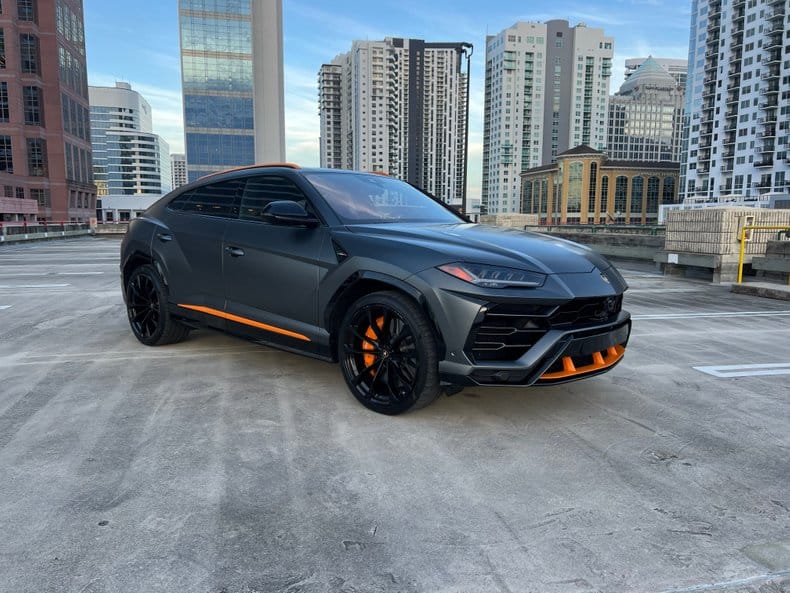
Our valuations for the Lamborghini Urus reflect how much this platform varies once you look past the badge: a twin-turbo V8 super SUV that business owners, collectors, and families have each made their own. It is one of the most versatile high-performance assets in its class, and we treat it accordingly. Whether you own an original pre-facelift model, a Performante, or the new SE hybrid, every vehicle is reviewed individually. Our 2026 tax strategy analysis and Montana LLC enforcement guide address the complexity many Urus owners face.
Our team personally manages every element of the transaction: title transfer, lien resolution, certified payment, and nationwide enclosed transport through our Bespoke Logistics division.
How It works

Tell Us About Your Exotic
Enter your VIN to auto-populate year, make, and model. Or start manually. Upload photos and note any modifications.

Market-Backed Proposal
A dedicated buyer reviews your vehicle against proprietary data and delivers a firm proposal, typically within one business day.

We Come to You
Enclosed Liftgate transport, licensed, bonded, and insured. Scheduled nationwide at your convenience.

Certified Funds & Fast Settlement
Once title clears, certified payment releases promptly. Clean-title vehicles often settle within 24 hours.

The Marque
The Lamborghini Urus
Selling a Lamborghini Urus is not a generic transaction. Outcomes shift meaningfully by variant, generation, service history, specification, and where a particular vehicle sits within a market that now spans four distinct production phases.
When evaluating a Lamborghini Urus, we focus on the factors that materially influence its market standing. Vehicle condition, service records, mileage context, original specification, and overall presentation are assessed together, not in isolation. Each car is reviewed individually, with attention to the details that distinguish one example from another and affect how it should be valued.
The Urus occupies a unique position as the highest-production Lamborghini ever built and one of the most actively traded exotic SUVs in the secondary market, a combination that makes forensic-level valuation intelligence essential for sellers navigating a deep and competitive inventory field. Below, we have classified Lamborghini Urus variants by market profile and published our current market overview for this model.
The Variants
Lamborghini Urus Variants We Actively Purchase
Well-presented Lamborghini Urus examples are actively purchased from private owners nationwide. Each vehicle is reviewed individually on condition, specification, service documentation, and overall presentation. Submissions outside the profiles listed below are evaluated on their own merits.
- Lamborghini Urus (2019–2022): Tactical Utility The original super SUV: 641 hp from a 4.0L twin-turbo V8, adaptive air suspension, and a GVWR exceeding 6,000 lbs; valuation is optimized by aligning with business-acquisition cycles and regional demand timing.
- Lamborghini Urus S (2023–2025): Tactical Utility Post-facelift successor with 657 hp, revised exterior, and updated cabin architecture; valuation responds to specification completeness and service continuity across the generation break.
- Lamborghini Urus Performante (2023–2024): High-Velocity Asset Track-focused variant: carbon fiber body panels, steel springs, titanium exhaust, 47 kg weight reduction; valuation is optimized by the factory options that separate it from standard S inventory.
- Urus Performante Essenza SCV12 Edition (2023): Bespoke Artifact Forty units globally, each matched to the owner's individual SCV12 hypercar livery; valuation is governed by unit identity, livery documentation, and plate position.
- Lamborghini Urus SE (2025+): Tactical Utility Lamborghini's first plug-in hybrid SUV: 789 combined hp, 37+ miles electric range, GVWR exceeding 6,000 lbs; valuation aligns with PHEV incentive timing and the vehicle's position as the current-production flagship.

The Provenance
Lamborghini Urus Market Intelligence: Supply Depth, Warranty Cliffs, and the Cost of Waiting
If you own a Lamborghini Urus, you own one of more than 30,000 built since 2018. That is not a limited-production talking point. It is a supply reality that shapes every transaction in this segment, and it means the variables that determine your vehicle's market outcome are different from those governing a numbered supercar: lease-cycle timing, carrying costs, and generation positioning matter more than scarcity.
In this report:
700 Listings and a Three-Year Lease Cliff
Between 700 and 900 Lamborghini Urus units currently sit in US dealer and private-party inventory. That is one of the deepest supply pools in the exotic SUV segment, surpassed only by the Porsche Cayenne, and it tells a specific story about where this market is headed.
The 2022 model year accounts for roughly 40% of all available listings. Not a coincidence. Three-year leases originated during the 2022 peak pricing cycle are maturing in bulk, flooding the pre-facelift tier with supply that did not exist 12 months ago. Every returning unit adds to a pool of vehicles that already face a structural headwind: the MY2023 refresh, which replaced the base Urus with the S and introduced the Performante, created a visible generation break that buyers use as a dividing line. Pre-facelift inventory sits on one side. Post-facelift sits on the other. The gap between them is widening.
Dealer asking prices currently overshoot actual transaction levels by 14% to 17%. That spread is visible in the data: price reductions of $10,000 to $30,000 appear across major listing platforms with regularity, and auction reserves fail to clear often enough that the pattern is no longer anecdotal. Year-over-year, aggregate pricing has declined approximately 3%. The trailing 90 days show a 7% recovery, likely seasonal. Don't read that as a reversal.
Depreciation Doubles After Warranty Expires
At the three-year mark, cumulative depreciation sits at roughly 16.7% of base MSRP. By year five, it reaches 34.1%. That is not a smooth curve. It is a step function, and the step is warranty expiration.
Lamborghini's standard coverage for pre-2025 models runs three years, unlimited mileage. For the SE and all 2025-forward production, the factory extended that to five years. When a pre-2025 Urus crosses the warranty threshold, the buyer pool contracts overnight: informed purchasers price in mechanical risk, uninformed purchasers leave the market entirely, and the result is roughly 17 percentage points of additional depreciation concentrated into the two years immediately following warranty lapse. That acceleration coincides precisely with rising maintenance exposure, and the compound effect is what makes the three-to-five-year window the most punishing ownership period for a seller who hesitates.
For context, the 34.1% five-year figure still outperforms the exotic SUV segment average by more than four points. Against direct competitors, the margin is brutal. The Bentley Bentayga Speed retains roughly 52% to 54% at the five-year mark. The Aston Martin DBX707 has shed nearly 48% of its value in just two years, documented by listings that now sit far below half of original sticker. The BMW XM Label Red collapsed to approximately 49% depreciation in the same window. Maserati's Levante Trofeo lost 51% in three years before the model was discontinued.
The Urus holds better than all of them. Only the Ferrari Purosangue outperforms it, and the Purosangue still trades above MSRP.
What the Next Service Invoice Costs
Routine maintenance is reasonable for the segment. Annual service runs $1,200 to $2,000 at a minor interval, $2,500 to $4,000 at the 27,000-mile major. A Urus driven 5,000 miles per year will consume $2,500 to $5,000 in scheduled work. At 10,000 miles, budget $5,000 to $10,000. None of these figures are alarming on their own.
$50,000 to $60,000. That is what a full set of OEM carbon ceramic brake rotors and pads costs. Rotors typically survive 50,000 to 70,000 street miles; pads wear through at 25,000 to 40,000. For the seller weighing exit timing, the calculus is direct: if your brakes are past 60% wear, the next owner will negotiate that replacement cost off the transaction price in full. Many owners convert to iron brakes at that threshold, dropping the bill to $5,000 to $8,000 but narrowing the buyer pool for collectors who expect factory-original specification.
Air suspension failures surface between 40,000 and 70,000 miles as uneven ride height, sagging at rest, or persistent warning lights. A full four-corner replacement at the dealer runs $10,000 to $15,000. Performante owners sidestep this entirely: steel springs, no air system, no exposure. Carbon buildup on the direct-injection V8's intake valves becomes noticeable around 30,000 to 50,000 miles, remedied by walnut blasting at $800 to $2,500 depending on the facility. Tires on 23-inch wheels run $4,200 to $5,300 per set, and the Urus chews through rear rubber at an accelerated rate under spirited driving.
Then add carrying costs. Insurance runs $3,500 to $6,600 annually, with Miami, Los Angeles, and New York pushing toward the ceiling. Combined with maintenance, storage, and registration, an out-of-warranty Urus consumes $10,000 to $20,000 per year in holding costs before it moves a single mile. For owners carrying specialty coverage on a vehicle approaching a major service interval, the overlap between total-loss exposure and deferred maintenance risk compounds the urgency. Every month of indecision is a line item.
Competitive Collapse Below, Price Compression Above
The Cayenne Turbo GT is the most rational alternative and applies steady pressure. It matches or exceeds the Urus on tested acceleration, enters the market at roughly 25% below equivalent Urus MSRP, and carries Porsche's engineering credibility with a buyer base that skews analytical rather than emotional. For the Urus seller, this means any buyer considering both vehicles has already done the math, and the Lamborghini badge needs to justify the delta.
Below the Urus, the competitive field is a depreciation graveyard. A two-year-old BMW XM Label Red now trades at roughly half its original sticker, a collapse so severe that it barely competes on brand anymore; it competes on price alone against vehicles a full tier below its original positioning. The DBX707 has shed nearly 48% in two years. The Levante Trofeo lost 51% in three and then ceased production, removing even the floor that continued manufacturing would have provided.
Above the Urus, compression is building. The Ferrari Purosangue began life trading at multiples of its base MSRP, but secondary-market values have softened meaningfully over the past 12 months, drifting toward overlap with a fully loaded Urus SE. That convergence doesn't threaten the Urus today. It changes the conversation in 2027.
Section 179 and the Bonus Depreciation Cliff
Every Urus variant carries a GVWR of approximately 6,327 lbs, comfortably exceeding the 6,000-lb threshold for "heavy vehicle" classification under IRS Section 179. With the One Big Beautiful Bill Act restoring 100% bonus depreciation for qualifying property placed in service after January 19, 2025, business owners can claim a first-year deduction equal to the full purchase price, subject to the $2.56 million Section 179 limit and 100% bonus on the balance.
That window has an expiration date. Bonus depreciation is scheduled to phase down again in future tax years, and the current 100% rate is the product of legislation that was contested for months before passage. Business owners who leveraged heavy-vehicle deductions between 2022 and 2024 now face a second timing question: rotating a depreciating Urus off the corporate balance sheet before out-of-warranty maintenance cliffs and depreciation recapture erode the original tax benefit. For a deeper analysis of the deduction mechanics and recapture risks, see our 2026 tax strategy guide.
The Urus market is normalizing, not collapsing. Pre-facelift models face the steepest headwinds from lease returns and warranty lapses; post-facelift Performante examples hold meaningfully stronger retention as the only track-focused, V8-only variant the Urus will ever produce. The seller's timing calculus is direct: carrying costs compound, depreciation accelerates post-warranty, and the SE's expanding presence pushes every V8-only model further from current production. Waiting is not free.
The Essentials
FAQs About Selling Your Lamborghini Urus
What happens after I submit my VIN?
Within one business day, our acquisitions team reviews your vehicle’s history, specification, and current market position against proprietary data. You receive a written acquisition proposal with a firm offer, not a range or an estimate. There is no negotiation phase: the proposal reflects the vehicle’s verified condition and the current market.
How does a direct acquisition differ from selling through an auction or consignment?
A direct acquisition is a single transaction between you and a licensed dealer. There is no public listing, no auction reserve gamble, no buyer premium, and no VIN exposure on platforms where price history follows the vehicle permanently. Settlement is direct: documentation to wire, without the 21-business-day clearing cycles or 4-to-8-month timelines that characterize auction and consignment channels.
Is the process confidential?
Yes. Your vehicle is never listed publicly, photographed for marketing, or exposed on any platform before acquisition. All communication, valuation, and transaction details remain between you and the acquisitions team. For owners where discretion is a priority, this is a foundational difference from any public sale channel.
Can Exotics Wanted acquire a vehicle with an active lien, a lease, or an LLC title?
Yes. Vehicles with outstanding liens from specialty lenders, active leases through manufacturer financial services, Montana or Wyoming LLC registrations, and multi-jurisdictional title histories are all evaluated and acquired. The administrative resolution, including lien payoff, entity dissolution, and title transfer, is handled as part of the transaction.
How is my vehicle transported?
Enclosed transport is coordinated directly after acquisition. Insurance liability transfers at the point of purchase, eliminating the coverage gap that private transactions leave open between the seller’s policy termination and the buyer’s policy activation. Pickup is scheduled around the seller’s availability; the seller is not responsible for delivery.
How long does the process take from initial contact to payment?
Timelines vary based on title complexity, but an acquisition with a clean title can close within days of an accepted proposal. Transactions involving lien payoffs, lease buyouts, or LLC dissolution require additional coordination but are managed to close as efficiently as the administrative process allows. Certified funds are issued at closing, not contingent on resale.
What if I want to sell another vehicle in the future?
Every completed transaction builds on the last. Identity verification, documentation preferences, and financial workflows are already established, which means subsequent acquisitions move faster with less administrative friction on both sides. Sellers who return also benefit from continuity with their acquisitions team: the context from previous transactions carries forward rather than starting from scratch.
