
Sell Your McLaren 765LT
FAST. SECURE. NATIONWIDE. EXOTICS WANTED

Start Your Valuation
"*" indicates required fields
Home » Sell Your Exotic Car » McLaren » McLaren 765LT
The Legacy
Selling a McLaren 765LT
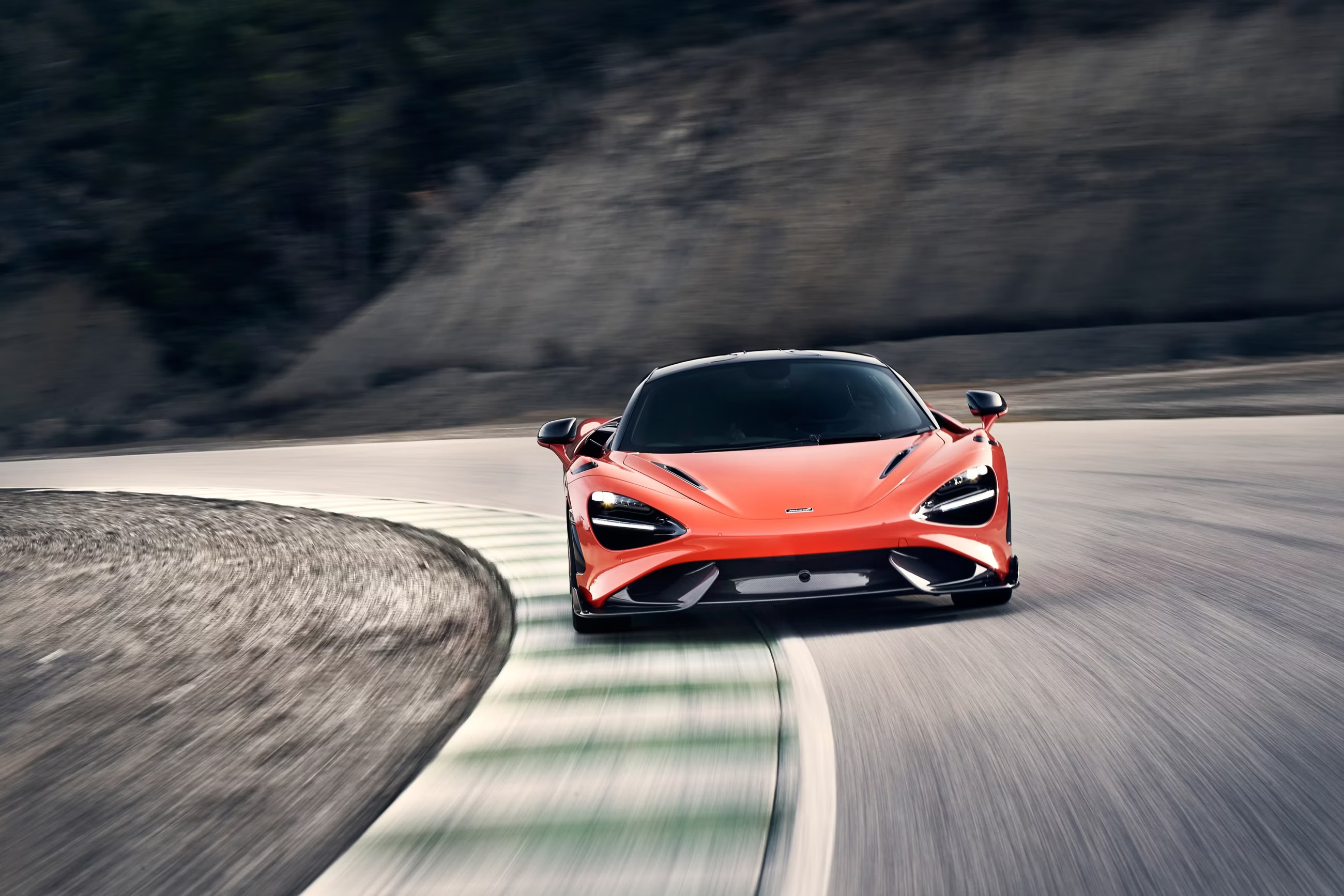
At Exotics Wanted, we understand that parting with your McLaren 765LT is a significant decision. With more than a decade in the high-performance vehicle market, our team recognizes what makes each model, generation, and specification unique.
Every McLaren 765LT valuation starts with what the car is, not what the market says it should be worth. The 765LT is McLaren's definitive Longtail, a twin-turbocharged V8 supercar that collectors and drivers treat as a category apart, and one we consider among the most compelling assets in its class. Whether you own the coupe or the spider, every vehicle is reviewed individually. Our 2026 tax strategy analysis and asset protection framework cover the regulatory and structural considerations that come with these cars.
Our team personally manages every element of the transaction: title transfer, lien resolution, certified payment, and nationwide enclosed transport through our Bespoke Logistics division.
How It works

Tell Us About Your Exotic
Enter your VIN to auto-populate year, make, and model. Or start manually. Upload photos and note any modifications.

Market-Backed Proposal
A dedicated buyer reviews your vehicle against proprietary data and delivers a firm proposal, typically within one business day.

We Come to You
Enclosed Liftgate transport, licensed, bonded, and insured. Scheduled nationwide at your convenience.

Certified Funds & Fast Settlement
Once title clears, certified payment releases promptly. Clean-title vehicles often settle within 24 hours.

The Marque
The McLaren 765LT
Selling a McLaren 765LT is not a generic transaction. For the 765LT, outcomes are shaped by factory specification, body style, documentation completeness, mechanical service history, and how the car has been stored and maintained since delivery. No two examples occupy the same position in this market.
When evaluating a McLaren 765LT, we focus on the factors that materially influence its market standing. Vehicle condition, service records, mileage context, original specification, and overall presentation are assessed together, not in isolation. Each car is reviewed individually, with attention to the details that distinguish one example from another and affect how it should be valued.
With only 1,530 examples produced worldwide across two body styles, the ownership realities, carrying cost arithmetic, and the production timeline that shapes what comes after this car determine where each car sits today. Below, we have classified McLaren 765LT variants by market profile and published our current market overview for this model.
The Variants
McLaren 765LT Variants We Actively Purchase
Exotics Wanted actively purchases well-presented McLaren 765LT coupes and spiders from private owners nationwide. McLaren limited production to exactly 1,530 individually numbered cars: 765 coupes delivered from late 2020 through 2022 and 765 spiders delivered from 2022 into early 2023. Both body styles share the same M840T 4.0-litre twin-turbocharged V8, the same 755 hp output, and the same Monocage II carbon-fibre architecture, yet they occupy distinct tiers in the secondary market separated by approximately 30% to 40% in transactional value. Every vehicle is reviewed individually on condition, specification, service history, and presentation. Submissions outside the profiles below are evaluated on their own merits.
- 765LT Coupe (2021-2022): Sovereign Icon The final Longtail in fixed-roof form, the lighter body style at 1,229 kg. Every coupe sold before the spider was publicly announced; production complete, no successor in the pipeline. Transactional divergence within the coupe market exceeds $60,000.
- 765LT Spider (2022-2023): Sovereign Icon The final convertible in McLaren's Longtail lineage; production complete, no successor announced. The spider attracted a collector base weighted toward multi-car stewards, with a higher proportion sitting at delivery miles than comparable coupes. Transactional divergence within the spider market exceeds $84,000.

The Provenance
McLaren 765LT: Valuation Divergence, ICE Exit, Annual Burn, and the Math Behind Retention
McLaren showed full-size models of every car it plans to build through 2030 at the November 2025 retailer meeting in Bicester. The McLaren 765LT is not in that pipeline. It was built as 765 coupes and 765 spiders, 1,530 cars total, and the line closed. Where each one sits in the current market comes down to factory-verifiable data that no public platform surfaces.
ECU calibration integrity, PCC II accumulator generation, and MSO specification documentation: each result is permanent and each carries measurable weight. Whether the intent is to sell your McLaren 765LT, hold through the summer reveals, or benchmark against current coupe and spider transaction data, the analysis starts here.
In this report:
- The Diagnostic Layer Public Platforms Cannot See
- PCC II Accumulators and the Three-Year Service Clock
- Recall 24V901000 and the 163 Unresolved Coupes
- 2026 Valuation Divergence: The $60,000 to $84,000 Spread on Standard McLaren 765LT Variants
- MSO Bespoke vs. MSO Defined: The Roof Scoop and the Commission Hierarchy
- How McLaren 720S Model Confusion Anchors a Longtail
- Fleet CO2, the Artura Offset, and the Production Plan Through 2030
- Retention Hierarchy: The McLaren 765LT Against Five Direct Competitors
- The $14,000 to $22,000 Annual Carrying Cost
- The Break-Even Calculation: What Retention Costs in Real Terms
- After Factory Coverage: Warranty Expiration and the 5,000-Mile Threshold
- Public Channel Sell-Through and the Modification Penalty
- Section 232, ESSB 5801, and the People v. Dhaliwal Precedent
- Selling Your McLaren 765LT in 2026: Stack Risk, the W1, and the Exit Timeline
McLaren 765LT Vital Signs
Total Production
1,530
765 coupes + 765 spiders
Accumulator Cycle
3-4 Years
Consumable service interval
Open Recall
163
Non-roof-scoop 2021 coupes
Spec Spread
30-40%
Coupe-to-spider transactional gap
The Diagnostic Layer Public Platforms Cannot See
Every McLaren 765LT carries a digital history, the first diagnostic gate, that no vehicle history report and no seller disclosure can refute. The McLaren Diagnostic System (MDS) stores a complete profile of how the M840T 4.0-litre twin-turbocharged V8 has been driven, serviced, and calibrated since delivery, and that record is permanent.
Independent diagnostic tools at specialist McLaren shops read the same proprietary modules the factory system reads: ECU calibration history, PCC II suspension faults, gearbox shift adaptations. A car that was flash-tuned and then reverted to stock retains evidence of the modification in its non-volatile memory. A car that threw a PCC Error at 14,000 miles and was repaired still shows the fault. Assume the buyer already knows.
Who Sees the Data vs. Who Acts on It
Independent Tools
Same Data
Specialist shops read full module history
Tune-and-Revert
Still Visible
Evidence persists in non-volatile memory
Factory MDS
Coverage Gate
Authenticated to McLaren head office
Flagged VIN
Permanent
CPO + ESC eligibility lost for all future owners
The difference between an independent scan and the factory MDS is what happens next: when a McLaren retailer connects the MDS, authenticated to head office, that digital history becomes a coverage decision. A VIN flagged for modifications loses eligibility for Certified Pre-Owned (CPO) certification and Extended Service Contract (ESC) enrollment, and that flag follows the chassis through every subsequent transaction.
What the MDS Records That OBD-II Cannot
ECU Flash History
Calibration Hashes
Tune-and-revert still visible in non-volatile memory
Fault Code Timeline
Every Module
PCC Error at 14K miles stays on record after repair
Clutch Adaptation
Shift Counts by Gear
Track abuse vs. street use written in the data
PCC II Fault Logs
Suspension Events
Fault history across every driving mode
The authentication question extends beyond the MDS. Aftermarket "MSO-style" carbon components, particularly roof scoops, side skirts, and splitters, are available from third-party fabricators at $72,000 or more for an installed kit. A car claimed as having a factory MSO roof scoop but lacking the engine-bay ducting and polycarbonate rear deck that distinguish the genuine $36,340 option from a $5,000 to $15,000 aftermarket replica is not an MSO car; it is a misrepresentation that any informed buyer will catch through the VOI build-sheet query. The factory MSO build sheet, retrievable at no cost through any authorized McLaren retailer, is the only document that confirms what left Woking on the car and what was added afterward.
PCC II Accumulators and the Three-Year Service Clock
$3,750 to $5,000. That is what it costs to replace all four Proactive Chassis Control II (PCC II) hydraulic accumulators on a McLaren 765LT, and the interval is three to four years regardless of mileage. Confirming which generation the car carries is the second diagnostic gate: these are consumable components, not permanent hardware, and the single highest-probability maintenance item within a ten-year ownership horizon.
The M840T engine itself is the most reliable system on the car; its Senna-derived three-layer head gasket is an improvement over the 720S two-layer unit, reducing detonation tendency and improving thermal transfer. The gearbox, a Graziano-built SSG seven-speed dual-clutch with wet clutches, is designed to last the life of the car under stock use, with a worst-case clutch replacement running approximately $25,000 at dealer rates. The accumulators, not the engine or transmission, are where the money goes.
Tenneco/Monroe Intelligent Suspension (GlobeNewswire, 25 October 2023): Monroe named Official Intelligent Suspension Supplier for McLaren road cars including the 765LT, supplying the CVSA2/Kinetic system that forms the hardware foundation of PCC II.
McLaren's PCC II system replaces conventional anti-roll bars with interconnected hydraulic dampers pressurized by four nitrogen-charged accumulators. When an accumulator loses pressure, the suspension locks into a degraded mode: "PCC Error, Mode Change Not Allowed" on the instrument panel, ride quality locked in Track regardless of the driver's selection, and an audible whine from the front of the car that confirms the system has failed. An authorized McLaren retailer charges approximately $4,600 installed including fluid flush; independent McLaren-trained specialists complete the work for approximately $4,500 turnkey. A set of four OEM accumulators costs $3,260 at current parts pricing, with single units running $505 each.
The critical distinction is generational. Cars built before May 2021 left the factory with original rubber-diaphragm accumulators carried over from the 720S. Cars built after May 2021 received the upgraded piston-style unit (part number 14BA254RP), which McLaren now retrofits into any 720S or early 765LT that presents for accumulator service. If the car you are considering selling still has original-specification diaphragm accumulators, the replacement is not optional; it is the first question an informed buyer will ask.
Any authorized McLaren retailer can confirm accumulator generation through a VIN query. If the service record does not specify the piston-style part number (14BA254RP), assume the original diaphragm units are still installed and budget $3,750 to $5,000 before listing.
Recall 24V901000 and the 163 Unresolved Coupes
NHTSA Recall Campaign 24V901000, filed November 28, 2024, covers exactly 163 units of 2021 McLaren 765LT coupes that were delivered without a factory-fitted roof scoop. The defect: a polycarbonate rear window that may detach under aerodynamic load, a failure mode that the roof-scoop variant does not share because its rear glass uses a different bonding process. Spiders are excluded entirely.
The remedy status in the Part 573 Safety Recall Report remains listed as "NR" (Not Reported) as of May 2026. Interim owner letters were mailed in December 2024. The remedy itself, a set of bespoke corner fasteners installed at no charge, was anticipated by late September 2025, but McLaren has not confirmed completion through the NHTSA filing system.
NHTSA Recall Campaign 24V901000 (filed November 28, 2024): 163 units of 2021 McLaren 765LT coupes without factory roof scoop. Defect: polycarbonate rear window bonding. Remedy status: "NR" (Not Reported) as of May 2026.
For sellers, this creates a binary documentation requirement. If your 2021 coupe lacks a roof scoop and falls within the affected VIN range, completed-recall paperwork in the sale file is not a courtesy; it is a condition of sale that buyers will verify through a direct NHTSA VIN lookup. Its absence is a documentation gap that informed buyers will flag before proceeding, creating logistical delay at minimum.
2026 Valuation Divergence: The $60,000 to $84,000 Spread on Standard McLaren 765LT Variants
The position of any individual McLaren 765LT within its tier is shaped by a mix of factory-verifiable details (accumulator generation, ECU history, MSO documentation), market conditions (timing, color preference, sales channel), and seller-controlled choices (documentation completeness, PPF coverage, delivery portfolio). These factors do not operate in isolation but compound and translate into a $60,000 to $84,000 spread across McLaren 765LTs of the same variant in the standard tier. For MSO-commissioned cars, that valuation cliff widens past $100,000, compounded by the distinction between MSO Defined catalog options and MSO Bespoke one-of-one commissions.
McLaren 765LT Factory Option Pricing
| Specification Element | Coupe (MY2021) | Spider (MY2022) |
|---|---|---|
| Base MSRP | $358,000 | $382,500 |
| MSO Defined Roof Scoop (factory) | $36,340 | N/A (Spider) |
| Senna Carbon Fibre Racing Seats | $7,580 | $7,580 |
| MSO Clubsport Pro Pack | $34,800 | $34,800 |
| MSO Defined Paint | $9,400 | $9,400 |
An MSO spider in a polarizing color with original diaphragm accumulators, a service-history gap, and no recall completion paperwork stacks discounts toward the floor of its tier, while another MSO spider in a market-preferred color with upgraded piston-style accumulators, a complete dealer service file, and documented PPF sits at the ceiling. The distance between those two cars is the $100,000 divergence quantified in the table below.
McLaren 765LT Divergence Cliff
| Tier | Units | MSRP | Min | Max | Divergence | Div % of Min |
|---|---|---|---|---|---|---|
| Standard Coupe | 12 | $358,000 | $385,000 | $445,000 | $60,000 | 16% |
| Standard Spider | 16 | $382,500 | $415,000 | $499,000 | $84,000 | 20% |
| MSO Coupe | 3 | N/A | $485,000 | $535,000 | $50,000 | 10% |
| MSO Spider | 5 | N/A | $550,000 | $650,000 | $100,000 | 18% |
A representative well-specified coupe left the factory with a window sticker exceeding $510,000. The options that drove that sticker, particularly the roof scoop, the Senna seats, and the full exterior carbon-fibre packs, now determine whether the car trades at 120% of base MSRP or closer to 190%. The gap is not a function of condition or mileage alone; it is a function of how the car was configured at the factory, verified through the MSO build sheet and the Vehicle Order Inquiry (VOI) record available through any authorized McLaren retailer.
Interior specification separates buyer pools as sharply as exterior color. Black Alcantara with McLaren Orange contrast stitching ($3,030) is the accepted standard; Senna Carbon Fibre Racing Seats ($7,580) are nearly mandatory for collector-tier buyers. Polarizing interiors, including pink stitching, purple Alcantara, and single-color non-contrast trim, narrow the buyer pool in the same way polarizing exterior colors do. The "sleeper" options that recover disproportionately to their factory cost are the double-glazed engine window ($8,470, coupe only, visually 765LT-defining), the electrochromic retractable roof ($9,090, Spider only), and the satin carbon steering wheel ($4,310). Documented PPF with a transferable warranty from a recognized installer is a documentation asset that informed buyers actively seek; undocumented or off-brand film carries no weight in due diligence. Over 25% of 765LT production was ordered with major MSO personalization, per McLaren press materials, meaning the build-sheet verification process is routine and expected by informed buyers.
"With all 765 examples of the 765LT coupe sold, it's no surprise that as we publicly announce our new LT Spider, production capacity for 2021 is already filled."
Mike Flewitt, CEO, McLaren Automotive (McLaren press release, 27 July 2021)
MSO Bespoke vs. MSO Defined: The Roof Scoop and the Commission Hierarchy
Not all MSO specifications are created equal, and the distinction between MSO Defined and MSO Bespoke is the single most misunderstood valuation driver on the 765LT. MSO Defined options are catalog items available to any buyer at published prices: the $9,400 paint palette, the $36,340 roof scoop, the carbon-fibre body panels.
MSO Heritage colors like Memphis Red and Azores carry a $12,359 premium. MSO Bespoke commissions start at $15,884 for factory-mixed unique colors and scale into six figures for Strata Theme graphics, Cerberus Pearl finishes, and full one-of-one interior specifications. At the extreme, an MSO Bespoke coupe cleared at approximately 190% of base MSRP at a major 2026 no-reserve auction, the highest public result for any 765LT coupe and a figure that no standard-specification example has approached.
Bonhams (Miami, May 2026): MSO Bespoke 2021 765LT Coupe in one-of-one Pistachio Green, no reserve. Result at approximately 190% of base MSRP including buyer's premium, the highest publicly recorded retention multiple for any 765LT Coupe.
The resale hierarchy follows the factory hierarchy. A documented MSO Bespoke car with a Commission Number and an MSO Certificate of Authenticity commands a premium that tracks the factory hierarchy. An undocumented car claimed as "MSO Bespoke" earns no premium at all and may actively suppress interest if buyers suspect misrepresentation. The authentication path is direct: any authorized McLaren retailer can query the factory build record through the VOI system and confirm every option, every paint code, and every MSO commission detail tied to the VIN.
The roof scoop deserves specific attention. At $36,340 from the factory, it is the single most recognizable specification element on a 765LT coupe. Aftermarket retrofit kits from specialists run $72,000 to $100,000 installed, and McLaren's own parts-counter price for the component alone is $47,095.74 before labor, confirming that the resale premium is anchored by genuine factory rarity rather than perceived aesthetics. Cars with the factory roof scoop consistently trade at the upper end of the coupe range; cars without it compete against every other standard-specification coupe on the market.
How McLaren 720S Model Confusion Anchors a Longtail
The Longtail badge separates the 765LT from the McLaren 720S at the factory, but on the secondary market, model confusion is actively compressing the perceived value of the 765LT for uninformed buyers. The 720S now trades below $260,000. The 750S lists at $445,000 to $450,000 MSRP with approximately 115 active listings across major aggregators at any given time.
The 765LT, with roughly 30 active listings, maintains a 3.8-to-1 supply advantage over the 750S, yet casual buyers who search "McLaren" without understanding the LT program see a pricing spectrum that starts at $260,000 and assume the 765LT is simply a slightly more expensive version of the same car.
A 720S-to-765LT body-kit conversion replicates visual components but cannot replicate the factory ECU calibration. The 765LT's Bosch ME17.8.3 engine management unit carries a unique calibration hash readable only through the McLaren Diagnostic System; any car presenting as a 765LT whose MDS profile does not match the factory LT calibration is exposed as a conversion regardless of exterior appearance.
Aftermarket body-kit manufacturers sell 720S-to-765LT visual conversion kits that replicate the front bumper, side skirts, and rear diffuser. When a converted 720S appears in search results at a fraction of genuine 765LT pricing, it drags the perceived floor downward. The dispersion is visible at the dealer level: one flagship retailer cut asking prices by roughly 25% and halved its used 765LT inventory, while another holds three units at nearly double base MSRP and a third has priced its entire stock below 140% of base MSRP. Dealer asking prices on 765LTs routinely exceed recent transaction outcomes by 15% to 25%, a spread that uninformed sellers internalize as the market rather than the aspiration. The seller's defense is documentation: the MSO build sheet, the VIN-decoded model designation (SBM14R for coupe, SBM14S for spider), and the factory-fitted LT-specific components that no conversion kit replicates, including the Monocage II carbon-fibre tub, the LT-specific lowered ride height, and the titanium exhaust.
Fleet CO2, the Artura Offset, and the Production Plan Through 2030
The UK's Vehicle Emissions Trading Schemes (VETS) require rising percentages of new-car registrations to be zero-emission: 28% in 2025, 80% in 2030, 100% in 2035. McLaren is exempt. On 7 April 2025, the UK government confirmed a small-volume manufacturer (SVM) derogation for any maker registering fewer than 2,500 cars per year in Great Britain, naming McLaren explicitly.
Department for Transport press release (7 April 2025): The revised ZEV mandate package "will also exempt small and micro-volume manufacturers, supercar brands including McLaren and Aston Martin, from the Mandate targets, preserving some of the UK car industry's most iconic jewels for years to come." Transport Secretary Heidi Alexander confirmed in the Commons the same day: "smaller and micro manufacturers are exempt from the ZEV mandate, but they will need to comply with the 2035 complete phase-out date, as per all other manufacturers."
In practice, the SVM derogation grants McLaren a 0% ZEV target through 2030: no obligation to sell a single zero-emission car this decade. The separate fleet CO2 standard within VETS still applies, but McLaren manages its fleet average through a single model. The McLaren Artura plug-in hybrid, whose CO2 rating sits well below the fleet threshold, offsets the emissions output of every non-electrified McLaren registered in the UK. The 750S and GTS are the only other models currently in production, and both end in 2027.
After 2027, McLaren's active production fleet shifts entirely to electrified powertrains. The pipeline through 2030: the Artura or its successor, a V8 plug-in hybrid four-door codenamed P47 due by 2028, and the 399-unit W1 hypercar at $2.1 million per car with deliveries underway and all units allocated. Every model carries a combustion engine. None is a pure internal-combustion car without electrification.
McLaren Production Fleet: ICE vs. Electrified, 2026 to 2028
2026 ICE
750S, GTS
Last pure combustion models
2026 Electrified
Artura, W1
PHEV and hybrid powertrains
2028 ICE
None
750S and GTS end in 2027
2028 Electrified
Artura, P47, W1
Full electrified production fleet
This fleet composition is why a pure internal-combustion Longtail successor is structurally unlikely rather than merely unannounced. Every non-electrified model McLaren sells consumes fleet CO2 headroom that the Artura's hybrid offset must cover. Adding a pure ICE Longtail into the fleet would push the average higher at the point McLaren needs it lower. The regulatory ratchet only tightens: post-2030, McLaren must negotiate a "nominal" CO2 reduction target with the Department for Transport, and by 2035 the SVM derogation expires entirely. All new cars sold in Great Britain from 2035 must be 100% zero-emission. No exception for small-volume manufacturers. Transport Secretary Alexander confirmed that explicitly. If you are asking whether to sell your McLaren 765LT, this regulatory architecture is what makes the "last ICE Longtail" thesis structural rather than speculative.
"I'll never commit to it formally, but I think it's likely to be the last non-electrified series-production V8 just around the regulations globally in respect to internal combustion. We would love to keep it going because there's something special about internal combustion and there's a market for it."
Charles Sanderson, Chief Technology Officer, McLaren Automotive (CarSales, 2023)
CEO Nick Collins told Autocar in April 2026 that "every model in McLaren's product plan through 2030 will feature a combustion powertrain." At the November 2025 global retailer meeting at the McLaren Creation Centre in Bicester, McLaren showed full-size models of that plan to its global retailer network (Automotive News, 12 November 2025). The car chosen to close the M840T V8 era carries a High Sport badge, not a Longtail designation: the 788HS, a limited-production final edition of the 750S. The Longtail lineage was not reopened.
CYVN Holdings, the Abu Dhabi sovereign-backed entity that completed its acquisition of McLaren in April 2025, cleared $800 million in legacy debt and committed more than $2 billion in fresh investment over five years. Annual production was cut to 2,000 units in 2025 from 3,189 in 2024: fewer cars, higher specification, higher margin. CYVN's EV development arm, Forseven, has been folded into McLaren Group Holdings, but no Forseven product has been pooled with McLaren Automotive for emissions purposes as of May 2026.
McLaren's SVM derogation exempts it from the UK ZEV mandate's annual EV-share targets through 2030, but the 2035 endpoint is binding: 100% zero-emission, no exceptions for small-volume manufacturers. The last two pure ICE McLarens in production, the 750S and GTS, both end in 2027. The 788HS represents the final chapter for the M840T V8 architecture. The window to rotate from an aging 765LT into a factory-new, zero-mile, full-warranty ICE McLaren is defined by that production calendar, not by market opinion.
For a 765LT owner weighing the next move, the production timeline and the maintenance timeline converge on the same calculation. Accumulator service is on a three-to-four-year clock regardless of mileage. First-delivery 2021 coupes have already exited factory warranty. ECU flash history is permanent, and a single modification flag can close the CPO path for every future owner. The cost of holding an aging 765LT rises on a fixed schedule; the supply of factory-fresh ICE McLarens falls on one. Both variables carry a deadline, and those deadlines are measured in quarters, not years.
Retention Hierarchy: The McLaren 765LT Against Five Direct Competitors
Retention percentage of original MSRP is the only metric that allows a clean comparison across different price bands, and on that measure, the 765LT holds a structurally defended position that its Smart Money scoring confirms. The fixed-supply dynamic that sustained the 675LT's 6.1% gain in 2024 per a McLaren-specific depreciation index (covering March 2023 through March 2024; no update has been published for 2025 or 2026) is the same dynamic at work here: 1,530 cars, zero additional production, and a Longtail collector base that does not rotate into volume McLarens.
Retention Percentage of Original MSRP
| Model | Retention (% of MSRP) | Global Production | Body Styles |
|---|---|---|---|
| McLaren 765LT | 120-140% | 1,530 | Coupe, Spider |
| Ferrari 488 Pista | ~144% | ~3,500 coupes / ~1,100 spiders | Coupe, Spider (Piloti Ferrari) |
| Porsche 991.2 GT2 RS | ~151% | ~1,000-2,000 (estimates vary) | Coupe, Clubsport |
| Lamborghini Huracan STO | ~105% | ~2,500 (estimate) | Coupe only |
| AMG GT Black Series | ~140% | ~1,700 | Coupe only |
| McLaren 720S | ~55-70% | ~4,200 coupes / ~2,500-2,800 spiders | Coupe, Spider |
The 720S is included deliberately. Its collapse to below 75% of MSRP is the gravitational pull that casual buyers apply to the 765LT, and the table makes the structural difference visible: 1,530 units versus approximately 7,000, Sovereign Icon scarcity versus volume production, and a retention band that has remained above MSRP since delivery while the 720S has fallen through it. The 488 Pista and GT2 RS trade at higher retention percentages, but both carry larger production runs and neither faces the model-confusion headwind that the 765LT absorbs from its own platform sibling.
"The wealthy buyer has not been affected by the turbid worldwide economic events, and they are willing and eager to spend."
Dave Kinney, Publisher, Hagerty Price Guide (Hagerty Media, 2026)
The Huracan STO is the cautionary comparison. At roughly 105% of its original MSRP, the STO has given back nearly all of its post-delivery premium despite a naturally aspirated V10 and a limited production run of approximately 2,500 units. The decline accelerated as Lamborghini transitioned the Huracan platform to the Temerario, confirming the pattern that concerns 765LT owners: when a successor arrives, the predecessor's premium compresses. The critical difference for the 765LT is that no successor has been announced. The 750S is a different car entirely, carrying no LT badge and no Longtail-program designation. Until McLaren or CYVN Holdings confirms a next-generation LT, the 765LT's retention position is defended by the absence of what would destroy it. If you are evaluating whether to sell your McLaren 765LT, this structural defense is the single most important variable.
The $14,000 to $22,000 Annual Carrying Cost
Retention percentages are a snapshot. The annual cost of holding that position is the number most 765LT owners have never aggregated into a single figure, and for a car that demands capital even when it sits under a cover, that figure determines whether the investment thesis survives contact with a spreadsheet.
McLaren 765LT Annual Carrying Costs
Insurance
$1,600-$4,500
Agreed-value collector policy
Storage
$4,800-$12,000
Climate-controlled facility
Service
$1,500-$3,500
Annual scheduled maintenance
Tires + Brakes
$2,700-$18,300
Per replacement cycle
Pirelli P Zero Trofeo R tires, the factory-specified compound, cost $2,700 to $3,300 per set and deliver 10,000 to 15,000 miles of street life or 3,000 to 5,000 miles of track life. A full set of carbon-ceramic brake discs runs approximately $15,000 installed. Registration varies by state: California charges approximately $5,000 to $6,500 annually on a vehicle valued at this level, while Florida runs $300 to $500 flat. Add quarterly professional detailing at $1,500 to $3,500 per year, and the all-in annual burn rate settles between $14,000 and $22,000 before any depreciation enters the calculation.
The Break-Even Calculation: What Retention Costs in Real Terms
The line items above are what it costs to hold a 765LT. The calculation below is what those costs mean for the investment thesis that most owners carry in their heads: that a car trading above MSRP is an asset that is working for them.
A 765LT coupe held at 120% of base MSRP carries a current market value near $430,000. At $14,000 to $22,000 in annual carrying costs, the car must appreciate approximately 3.8% every year just to cover what it costs to hold. At that rate, the owner nets zero on the car itself. The same $430,000 in a brokerage money-market fund at current competitive yields would return over $15,000 a year with no carrying costs at all. The retention number on the listing sheet says the car is ahead. The full math, carrying costs plus forgone yield, says most owners who believe they are building equity are standing still or falling behind.
The insurance line alone carries a hidden friction: The dominant collector-car insurer consistently refuses prospective McLaren owners (our total loss protocol guide explains the agreed-value stakes) who lack prior supercar experience on their policy history, per multiple owner forum reports. Alternative specialty insurers underwrite more broadly and have quoted roughly one-third of the premium in documented owner comparisons.
After Factory Coverage: Warranty Expiration and the 5,000-Mile Threshold
McLaren's three-year factory warranty carries no mileage limit, but the calendar does not care about odometer readings. First-delivery 2021 coupes began falling out of factory coverage in late 2023, and by mid-2026 the majority of the 1,530-unit production run is operating without factory protection.
The McLaren Extended Service Contract (ESC), available in 12- or 24-month increments to a maximum vehicle age of 15 years and fewer than 75,000 miles, runs $6,300 to $9,000 per year at 2026 dealer-quoted rates as the only remaining coverage. McLaren's Certified Pre-Owned (CPO) program is the alternative path, with coverage and eligibility terms that determine whether the car carries a recognized quality signal or a warranty-gap disclosure.
McLaren Certified Pre-Owned Program (cars.mclaren.com): Coverage of 12 to 24 months depending on vehicle and retailer. Eligibility requires under 40,000 miles, McLaren genuine parts only, and a multi-point dealer inspection. Track-day eligibility retained for non-competitive events with $300 pre- and post-track inspections.
The CPO designation is the single most recognized quality signal to informed buyers; its absence on an out-of-warranty car is the first thing an informed buyer questions.
Mileage interacts with spec in ways that generic depreciation models miss entirely. The collector market treats 5,000 miles as a threshold: below it, the car sits in the stewardship tier where documentation and specification drive the conversation. Above it, the car enters the enthusiast tier where condition and maintenance history carry more weight. A 6,000-mile coupe with a roof scoop, Senna seats, and an unbroken dealer service file trades in a fundamentally different band than a 6,000-mile standard-specification coupe with two missing service stamps. Mileage is not automatically negative. Documented mileage on a well-maintained car is provenance. Undocumented mileage is a discount. Documentation density is the single highest-impact variable a seller controls.
- Original Window Sticker + MSO Build Sheet: Factory-verified specification record; retrievable through any authorized McLaren retailer via VOI query at no cost.
- Complete Dealer Service Portfolio: Every scheduled and unscheduled service receipt in chronological order, including accumulator replacement documentation with part number confirmation.
- PPF and Ceramic Coating Warranty Cards: Transferable warranties from recognized installers carry measurable weight in due diligence; undocumented or off-brand film carries none.
- Both Keys with Carbon Fobs + Factory Car Cover: Missing items signal incomplete stewardship; replacement carbon key fobs run $2,500 to $3,500 through McLaren.
- Recall Completion Paperwork (if applicable): For 163 non-roof-scoop 2021 coupes under Campaign 24V901000, completed-recall documentation is a condition of sale.
The 10,000-mile mark introduces a second shift. Above it, the car exits the collector conversation almost entirely for standard-specification examples and enters a performance-enthusiast market where the buyer's primary concern is mechanical condition rather than investment thesis. For MSO-specified cars, the 10,000-mile threshold is softer because the specification itself carries independent collector value, but the seller should still expect the conversation to shift from "what is this car worth" to "what is the maintenance history on this car." The ESC, at $6,300 to $9,000 annually, becomes the single most valuable investment a seller can make before listing: converting a "no factory warranty" disclosure into a "warranty through 2030" selling point at a cost that converts a warranty-gap disclosure into a covered-vehicle disclosure. If you plan to sell your McLaren 765LT while factory warranty coverage remains transferable, understand this: the calendar is the constraint, not the odometer.
Public Channel Sell-Through and the Modification Penalty
The dominant online enthusiast auction platform processed $1.7 billion in sales across 49,486 auctions in 2025 at a platform-wide sell-through rate of 81.8%. That figure is impressive in aggregate and misleading for the 765LT specifically. The Serpentine Spider, consigned through a major online auction, hammered at an above-MSRP bid in November 2022 and then collapsed when the buyer walked during due diligence over undisclosed aftermarket downpipe installation.
The car was subsequently relisted through a dealer at an aspirational asking price and sat unsold. At a major national auction, a 765LT Spider consigned with reserve failed to sell despite bidding that reached above-MSRP territory. The auction format and the 765LT are not always a natural fit.
Every public auction creates a permanent digital record. A reserve-not-met result, a withdrawn listing, or a completed sale that later falls through remains indexed and searchable indefinitely on the platform, on Google, and on market aggregators and auction result databases. For a car whose value depends partly on perceived scarcity and market strength, a public failure is not just a missed transaction; it is a VIN-level data point that every future buyer will discover.
The alternative to public exposure carries its own risk profile, one measured in wire transfers rather than listing archives.
The settlement infrastructure for private exotic-car transactions above $250,000 remains effectively unprotected: no standard escrow protocol, no identity verification requirement, and no recourse mechanism comparable to a credit card chargeback.
FBI Internet Crime Complaint Center (IC3): Business Email Compromise losses reached $3.05 billion in 2025, with documented cases of six-figure wire fraud in exotic-car transactions between dealerships.
The private-sale alternative introduces its own friction: scheduling PPIs with traveling specialists, coordinating specialty lien payoffs across state lines, and managing the trust gap inherent in wiring $500,000 to a stranger's bank account.
The modification penalty is the sharpest edge in the market. A documented ECU tune, aftermarket exhaust with downpipes, or visible suspension modifications compress demand significantly below unmodified equivalents of comparable specification and mileage. The spread between modified and unmodified examples routinely exceeds the original cost of the modifications themselves, a reminder that the McLaren Artura and future McLaren products will inherit the same MDS-driven warranty architecture.
McLaren has confirmed through dealer communications that aftermarket downpipe installation voids powertrain warranty coverage regardless of whether an ECU flash accompanies the modification. The company actively monitors enthusiast forums and social media for evidence of modifications tied to specific VINs. A car flagged in this process can lose CPO eligibility permanently.
Channel economics compound the risk. The leading online auction platform charges the seller $99 with a $7,500 capped buyer fee. Nationally televised no-reserve auctions take 8% of the hammer plus $450 to $1,500 in entry fees. At least one international platform charges the seller nothing, with a $5,000 capped buyer fee. The math favors the lowest-fee platforms on paper, but the stale-listing data tells the real story: 45 days without a serious offer is the warning signal, 90 days is the "perceived overpriced" inflection where informed buyers assume something is wrong, and 120 days or more means the car has been publicly stigmatized. Repricing 2% to 3% every 30 days is the standard response, but each reduction is visible on the listing timeline and archived permanently.
Section 232, ESSB 5801, and the People v. Dhaliwal Precedent
Three regulatory shifts have changed the 765LT exit calculus since 2025: Washington's ESSB 5801 luxury tax adding approximately $32,000 to a $500,000 transaction, California's People v. Dhaliwal criminal prosecution naming a 765LT Spider in its vehicle exhibit list, and the UK-US Section 232 tariff quota now flagged for quarterly review.
The 765LT's UK manufacturing origin at Woking makes it directly subject to the Section 232 tariff regime and the US-UK Economic Prosperity Deal's quarterly quota administration in a way that a car built in Maranello or Zuffenhausen is not. Under Executive Order 14309, UK-origin passenger vehicles within a 100,000-unit annual quota pay a combined 10% tariff (2.5% Most Favored Nation plus 7.5% Section 232). Above the quota, the rate reverts to 27.5%. McLaren sold 1,270 units in the US in 2024, and total UK automotive exports sit comfortably within the quota for now, but quarterly quota fill rates in 2026 are being monitored and the quota itself is flagged for review per CBP Quota Bulletin 26-508. Any tightening in this regime raises new McLaren sticker prices and indirectly supports secondary-market values for existing 765LTs.
ESSB 5801 (Washington State, effective January 1, 2026): An 8% luxury tax on the portion of any motor vehicle's selling price above $100,000. Threshold escalates 2% annually each July 1.
On a 765LT transacting at a representative level, the additional tax burden reaches approximately $32,000 on top of regular state and local sales tax. For a seller domiciled in Washington, the tax exposure on exotic vehicle transactions in 2026 is now a material line item in any exit calculation.
Washington's luxury tax is a cost the seller can calculate. California's enforcement action is a risk the seller cannot.
People v. Dhaliwal, Case No. 26FE003384 (Sacramento County Superior Court, filed February 23, 2026): 56-count felony complaint against 14 defendants. Vehicle exhibit list includes a McLaren 765LT Spider, McLaren Elva, Porsche 918 Spyder, Ferrari 488 Pista, and Lamborghini Aventador Ultimae.
The charges span conspiracy, false sales tax returns, perjury, and money laundering across approximately $18.8 million in vehicle transactions and $1.6 million in unpaid taxes, making it the first publicly filed criminal case to name a McLaren 765LT.
The California Department of Tax and Fee Administration (CDTFA) has identified approximately 500 California dealers involved in more than 2,500 Montana LLC registration transactions since 2023. For any 765LT currently titled through a Montana LLC and primarily garaged in a state that assesses sales or use tax, the compliance risk is no longer theoretical.
"When bad actors abuse legal loopholes and submit fraudulent documents to evade their obligations, the California Department of Justice will not stand idly by. Every dollar of unpaid taxes is a dollar taken from California's roads, schools, and the vital services our communities rely on."
Rob Bonta, Attorney General, State of California (OAG press release, 2026)
The tax architecture surrounding a 765LT exit is more punitive than most sellers expect. The One Big Beautiful Bill Act (OBBBA), signed July 4, 2025, permanently set the federal estate tax exemption at $15 million per individual ($30 million per married couple) with inflation adjustments beginning 2027; for 765LT owners in the $15 million to $50 million net-worth band, the permanent high exemption substantially reduces the urgency to liquidate appreciating exotic assets from estates, particularly when combined with the unchanged step-up in basis at death.
Tax Architecture at Exit
Estate Exemption
$15M / $30M
OBBBA permanent, inflation-adjusted from 2027
Section 179 Year-1 Cap
$20,400
IRC §280F, under 6,000 lbs GVWR
Collectibles Rate
28% + 3.8%
Not the 15–20% long-term equities rate
1031 Deferral Options
Zero
Unavailable for vehicles since 2017
Section 179 deductions on the 765LT are limited by Internal Revenue Code (IRC) Section 280F to $20,400 in the first year because the car's gross vehicle weight rating falls well below the 6,000-pound threshold that unlocks accelerated expensing on heavy SUVs. Federal capital gains on a 765LT held longer than one year are taxed as collectibles at a maximum 28% rate under IRC Section 1(h)(5), not the standard 15% to 20% long-term rate that applies to equities, plus 3.8% Net Investment Income Tax (NIIT) if the seller's income exceeds threshold amounts. Section 1031 like-kind exchanges have been unavailable for vehicles since the Tax Cuts and Jobs Act of 2017 limited that provision to real property; the OBBBA did not restore it. There is no path to defer gain from a 765LT sale into another exotic car.
Selling Your McLaren 765LT in 2026: Stack Risk, the W1, and the Exit Timeline
The Longtail program has survived three generations without a successor stacking on top of it. The 720S collapsed when the 750S arrived, but no 750S LT and no Artura LT has been announced. Whether the 765LT's position as the last ICE Longtail holds or collapses depends on what CYVN Holdings reveals this summer.
Forum consensus on McLaren Life is weighted heavily toward "no" on a 750S LT, with the strongest contrarian argument pointing to CYVN Holdings' need to amortize the W1's new MHP-8 V8 engine into the broader lineup, potentially as a hybrid successor LT with a reveal in 2027 and deliveries in late 2027 or early 2028.
Financial Times (12 January 2026): CYVN Holdings has committed more than $2 billion in investment over five years to McLaren Group Holdings, cleared $800 million in legacy debt, and cut annual production to 2,000 units in 2025 from 3,189 in 2024.
This summer changes everything, or it changes nothing.
That investment bought McLaren a clean balance sheet and a five-year product runway, not indefinite patience. Collins has signaled the timeline precisely.
"From this summer, we start to go external, whether it's because we're starting to deliver W1s or because we're showing you product."
Nick Collins, CEO, McLaren Group Holdings (Autocar, 17 April 2026)
Every McLaren launching before 2030 has been shown to dealers as a full-size model. The 399-unit, $2.1 million W1 is fully allocated and does not compete with the 765LT on price, but what follows the W1 in the product pipeline is the single biggest forward-looking catalyst for 765LT values. The macro signal is already decelerating: The collector-car Supercar Index surged 19% in Q1 2026, driven by Ferrari halo cars (288 GTO +106%, Enzo +109%, Carrera GT +55%), then rose just 1% in Q2. The wave that lifted all limited-production supercars in Q1 is flattening, and the 765LT's own trajectory will increasingly depend on model-specific catalysts rather than segment momentum.
The Porsche 992 GT2 RS, leaked at approximately 450,000 euros German list and expected to land in the US at $650,000 to $750,000 with tariff markup, does not undercut the 765LT. It validates the segment and reinforces the 765LT's position as the more accessible track weapon within the competitive set.
No McLaren Longtail successor has been announced, and the competitive set validates rather than undermines the 765LT's price band. The summer 2026 CYVN product reveals at Goodwood and Monterey are the single decision point: if no successor LT is shown, the "last ICE Longtail" thesis hardens. If one is announced, the 765LT's retention premium compresses on the same timeline that destroyed the 720S when the 750S arrived.
Roughly 55% to 70% of 765LTs at this price band were purchased with cash, and an estimated 20% to 35% are held in LLC or trust structures that add title-transfer complexity to any exit.
What does this mean for your timing? If your car is a standard-specification coupe without MSO options, the window between now and Q3 2026 offers the clearest exit path before stack-risk clarity arrives from the summer product reveals at Goodwood and Monterey. If your car is MSO-specified with roof scoop, Senna seats, or a documented Bespoke commission, the data supports holding through those reveals; MSO-tier 765LTs have demonstrated resilience even as base-specification examples have softened. For the 5% to 10% of 765LTs on open-end leases, the positive equity position on well-specified cars can represent substantial unrealized capital above residual, equity that a structured dealer buyout captures in days rather than the months a private-party lease-buyout-and-resale cycle requires.
Every McLaren 765LT currently trades within a $60,000 to $100,000 valuation spread inside its own specification tier. McLaren is producing the final ICE era models: the McLaren 750S, the McLaren GTS, and the direct successor to the McLaren 765LT, the McLaren 788HS. These are the last pure internal combustion engineering achievements McLaren will build; production on the 750S and GTS ends in 2027, when the final ICE, the 788HS, begins production. The 788HS build completes before 2030. The end of an era. The transition from a Longtail into McLaren's final factory units, zero-mile, full-warranty ICE cars that will not be built again, is a limited opportunity worth exploring.
The Essentials
FAQs About Selling Your McLaren 765LT
What happens after I submit my VIN?
Within one business day, our acquisitions team reviews your vehicle’s history, specification, and current market position against proprietary data. You receive a written acquisition proposal with a firm offer, not a range or an estimate. There is no negotiation phase: the proposal reflects the vehicle’s verified condition and the current market.
How does a direct acquisition differ from selling through an auction or consignment?
A direct acquisition is a single transaction between you and a licensed dealer. There is no public listing, no auction reserve gamble, no buyer premium, and no VIN exposure on platforms where price history follows the vehicle permanently. Settlement is direct: documentation to wire, without the 21-business-day clearing cycles or 4-to-8-month timelines that characterize auction and consignment channels.
Is the process confidential?
Yes. Your vehicle is never listed publicly, photographed for marketing, or exposed on any platform before acquisition. All communication, valuation, and transaction details remain between you and the acquisitions team. For owners where discretion is a priority, this is a foundational difference from any public sale channel.
Can Exotics Wanted acquire a vehicle with an active lien, a lease, or an LLC title?
Yes. Vehicles with outstanding liens from specialty lenders, active leases through manufacturer financial services, Montana or Wyoming LLC registrations, and multi-jurisdictional title histories are all evaluated and acquired. The administrative resolution, including lien payoff, entity dissolution, and title transfer, is handled as part of the transaction.
How is my vehicle transported?
Enclosed transport is coordinated directly after acquisition. Insurance liability transfers at the point of purchase, eliminating the coverage gap that private transactions leave open between the seller’s policy termination and the buyer’s policy activation. Pickup is scheduled around the seller’s availability; the seller is not responsible for delivery.
How long does the process take from initial contact to payment?
Timelines vary based on title complexity, but an acquisition with a clean title can close within days of an accepted proposal. Transactions involving lien payoffs, lease buyouts, or LLC dissolution require additional coordination but are managed to close as efficiently as the administrative process allows. Certified funds are issued at closing, not contingent on resale.
What if I want to sell another vehicle in the future?
Every completed transaction builds on the last. Identity verification, documentation preferences, and financial workflows are already established, which means subsequent acquisitions move faster with less administrative friction on both sides. Sellers who return also benefit from continuity with their acquisitions team: the context from previous transactions carries forward rather than starting from scratch.
