
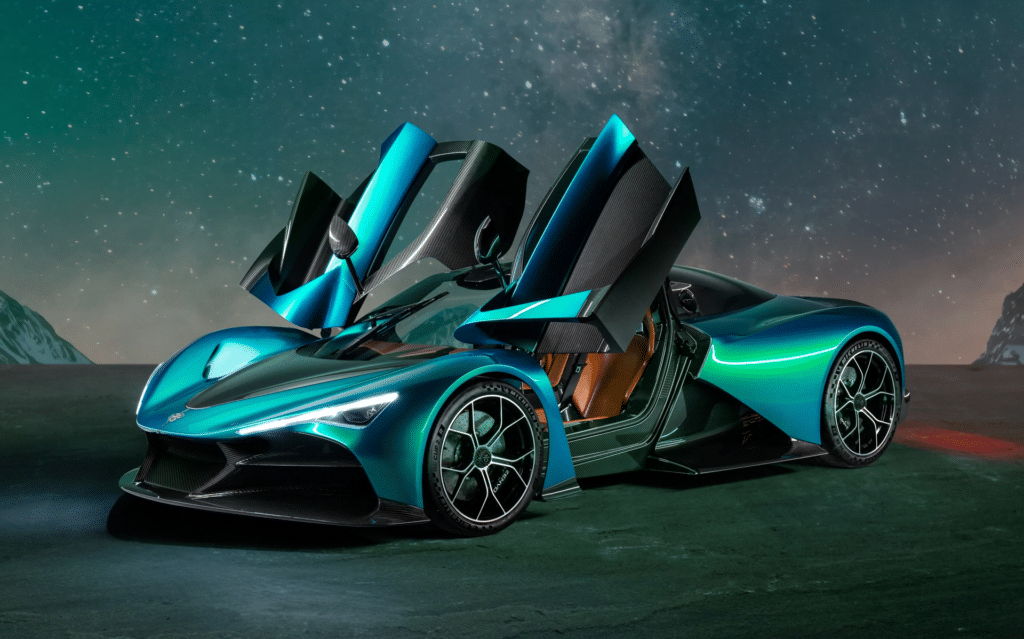
This analysis maps the CO2 emission phase-out and forced electrification regulations now confronting exotic and performance marques, classifying manufacturers as exempt, derogated, or obligated so each brand’s compliance horizon can be understood clearly. By identifying the regulatory runway available to each marque, the report evaluates the marque-specific engineering strategies now taking shape, as each manufacturer converts the same regulatory pressure into a different technical answer, from hybrid integration and synthetic-fuel development to full electrification. The objective is to show how legacy performance manufacturers are designing future product cycles around binding emissions rules while preserving the performance identities that made them valuable in the first place.
In this report:
- Jurisdictional Sovereignty
- The European Union’s Fleet Standard
- The UK Schedule Cliff
- Washington’s Reversal under President Trump
- Australia: A Fleet Target Without Small-Volume Shelter
- The Regulatory Tier Matrix
- Timeline of First Electrified Performance Programs by Marque
- Ferrari: Vertical Integration as a Performance Moat
- Lamborghini: The Concentrated Hybrid Position
- Porsche: Synthetic E-Fuels as an Institutional Hedge
- Mercedes-AMG: The Bifurcated Performance Strategy
- McLaren: Volume Discipline as Regulatory Shelter
- Aston Martin: The Threshold-Watch Row
- Bugatti & Rimac: Why In-House Electronic Architecture Wins
- Maserati: Reversing the Electric Pledge
- Corvette: The Regulatory Outlier in the Derogated Band
- Bentley & Rolls-Royce: Heavy Flagships in Pooled Fleets
- Lotus: The Downside of Disconnected Undertakings
- The Holdouts: Rarity Without Regulatory Targets
- Conclusion
- FAQ
The change traces to the 2015 Paris Agreement, the international climate commitment that the European Union, the United Kingdom, and the United States each answered with binding laws of their own. But as with most broad legislation, CO2 targets written for mass-market fleets also fall on manufacturers building so few cars that the value of the reductions extracted from them is questionable. Paris itself set no tailpipe standards; each jurisdiction wrote its own.
Burning fuel produces CO2, and an internal combustion engine cannot reach zero emissions. A marque whose new-car fleet must average zero by law cannot sell a single new car with an internal combustion engine.
Whether a marque must comply, and against which milestones, depends on registration numbers, counted not only for the marque itself but across the fleet of the group that controls it.
McLaren, an independent OEM, is assessed on its own registrations. Because it remains below the relevant volume threshold, it carries no fleet emissions target and remains exempt. Lamborghini’s registrations are counted as part of the Volkswagen Group fleet, placing the marque inside the group’s binding emissions obligation rather than its own small-volume category. The difference stems from how the law attributes each marque’s registrations.
Jurisdictional Sovereignty
The European Union’s Fleet Standard
Regulation 2019/631, adopted in 2019 and tightened in 2023, requires that a marque’s emissions, averaged across every car it registers in a year, reach zero by 2035. The regulation also sets out the exemption: a marque that remains below the volume threshold on its own, and is not counted within a larger group, falls outside the requirement. That is where the EU draws its line, by volume and by control.
The 2035 target is now under challenge. On December 4, 2025, the prime ministers of Italy, Poland, Bulgaria, the Czech Republic, Hungary, and Slovakia sent a joint letter to Commission President Ursula von der Leyen, urging her to preserve the sale of hybrids beyond 2035 under the principle of technological neutrality and warning that the transition was being pursued at the expense of European industry.
“There is nothing green in an industrial desert.”
The six prime ministers’ joint letter, December 4, 2025
Germany pressed the same case in a separate letter from Chancellor Merz, and together those governments represent close to half the EU’s population. Within two weeks the Commission responded, proposing on December 16, 2025 to soften the 2035 target to a 90 percent reduction, with the remaining 10 percent to be met not by zero-emission vehicles but by e-fuels, biofuels, or low-carbon European steel. It is a proposal, not law, and its passage is far from assured.
“Our goal should be a technology-neutral, flexible, and realistic CO₂ regulation that meets the EU’s climate protection targets without jeopardizing innovation and industrial value creation.”
Friedrich Merz, Chancellor of Germany, in a letter to the EU reported by Bloomberg
Companies that have already invested in the transition to an electrified future want the deadline left unchanged, their interests no less commercial than those of the premiers, but aligned in the opposite direction. In an open letter to von der Leyen, more than 200 chief executives urged her to “stand firm” on the 2035 date. The signatories lead the charge point operators that run the public charging network, the EV battery manufacturers behind the gigafactories in France and Germany, the utilities, and the material suppliers. By their own account they have committed hundreds of billions of euros and created more than 150,000 jobs, from those gigafactories to retooled car plants in Slovakia and Belgium to charging networks across the continent, all dependent on the deadline remaining in place.
“Maintain the full integrity of the 2035 zero-emissions target for cars and vans in your upcoming review. Back it up with bolder action to secure Europe’s industrial leadership in the electric age.”
Open Letter to President von der Leyen, signed by 200+ European business leaders, December 15, 2025
None of that is about exotics. The capital and the jobs belong to the mass market, the affordable electric cars and the factories built to make them, not the few thousand supercars sold each year. The exotic marques fall under the same law, but they are not its target, and the smallest among them are exempted precisely because their volumes are too small to matter. Two of the letter’s signatories, Polestar and Volvo, are controlled by China’s Geely. Until the co-legislators act, the 100 percent target stands; and the country that already builds most of the world’s electric cars and their batteries gains either way.
The four jurisdictions at a glance
| Jurisdiction | Instrument | Small-volume / exotic exemption | The 2035 endpoint |
|---|---|---|---|
| European Union | Regulation 2019/631 | Permanent de-minimis under 1,000; small-volume derogation to 2035 | 0 g/km from 2036; a 90 percent softening is proposed, not law |
| United Kingdom | Vehicle Emissions Trading Scheme | Micro and small-volume exempt from interim targets | 2035 phase-out applies to every manufacturer, the exempt included |
| United States | Federal vehicle standards | Standards being unwound | No federal end date |
| Australia | New Vehicle Efficiency Standard (2025) | None: no small-volume or exotic carve-out | Same fleet obligation as the mass market |
The UK Schedule Cliff
Britain also separates manufacturers by registration volume, but its exemption works differently from the EU’s. Under the Vehicle Emissions Trading Scheme (VETS), small and micro-volume manufacturers are exempt from interim zero-emission and CO2 targets, which protects most exotic marques through the current decade. However, this exemption does not carry past the 2035 phase-out. After that date, every manufacturer must comply, including the low-volume marques that faced no interim target before then. For a small marque, the British schedule is not a gradual ramp but a cliff: no fleet obligation now, then the full phase-out at once. After 2035, Britain becomes stricter than the EU because it gives the smallest manufacturers no permanent shelter.
Washington’s Reversal under President Trump
Washington’s reversal now rests on three instruments that changed the economic and legal pressure on U.S. product planning:
- CAFE penalties reset to zero: Section 40006 of the One Big Beautiful Bill Act, enacted July 2025, left the fuel-economy standards in place but reset the civil penalty for noncompliance to zero dollars. The standard still exists; the financial consequence that priced noncompliance into the fleet has been removed.
- California waiver disapprovals: In June 2025 Congress used the Congressional Review Act to disapprove California vehicle waivers, including the pathway that supported the state-led 2035 zero-emission sales mandate. California has signaled legal challenges, though the CRA’s limits on judicial review make the outcome uncertain.
- Endangerment Finding rescission: EPA’s February 2026 final rule rescinded the 2009 greenhouse-gas endangerment finding for motor vehicles and repealed the vehicle greenhouse-gas standards built on that finding. That action removes the current federal Clean Air Act basis for regulating vehicle greenhouse gases. The rescission rests on statutory interpretation rather than a challenge to the underlying science, and the ongoing litigation contests that interpretation.
Together, these actions move the U.S. framework from compliance pricing toward product-margin discretion. In Europe, a high-emission performance car must be offset inside a fleet average or protected by an exemption; in the United States, the current federal system places far less direct cost on the combustion car itself. That changes the internal business case for American performance programs. A Corvette, Mustang GTD, or future low-volume halo car can be justified more directly by contribution margin, customer demand, and brand value.
“Today is a victory for common sense and affordability.”
Jim Farley, President and CEO, Ford Motor Company
Farley’s response captures the business consequence. The reversal does not guarantee the future of the combustion halo car, and it does not remove every regulatory constraint from U.S. product planning. It changes the investment test. A performance program still has to earn approval, but the case no longer has to price in the cost of carrying the car as a compliance liability.
Australia: A Fleet Target Without Small-Volume Shelter
Australia’s New Vehicle Efficiency Standard measures the average CO2 emissions of a marque’s new vehicle registrations against the annual target assigned to that fleet. Australia does not offer a small-volume exemption, and small-volume marques like Ferrari and McLaren must account for any excess CO2 through credits or compliance payments. That exposure is sharper for high-emission marques with narrow product ranges, because they have fewer low-emission Australian registrations available to bring the fleet average down.
The Regulatory Tier Matrix
Those are the four laws. Each applies the same test: who controls a marque’s fleet, and how much it registers. Under that test, every marque falls into one of three positions. The matrix below sets out where each one lands, under the EU and under the UK.
Forced Electrification · Regulatory Tier Matrix
How the EU and the UK classify the exotic and luxury marques under their CO2 standards
Two separate jurisdictions, each with its own volume cutoffs for exemption and its own CO2 targets. A new car falls under EU standards or UK standards according to where it is registered. The manufacturer column groups each marque by how it is assessed: as an individual with no group parent, as a standalone line inside a group, or as part of a pooled group fleet. Status (exempt, derogated, or obligated) is shown per jurisdiction. The same brand can be exempt on one side of the Channel and obligated on the other. The status pills are an at-a-glance summary; the glossary beneath the table gives the statutory term and source behind each.
| Manufacturer Ownership / control |
European Union (Reg 2019/631, EEA registrations) | United Kingdom (VETS, GB registrations) | ||
|---|---|---|---|---|
| Volume (EEA, 2023) |
Status & timeline | Volume (GB, 2024) |
Status & timeline | |
| Independent marqueAssessed on its own. | ||||
| McLarenIndependent (CYVN-owned; no carmaker-group fleet) | 200 | Exemptde-minimis (DMD)Permanent. No target at any date, including past 2035. | 235 | Exemptmicro-volume (MVM)No interim target. 2035 phase-out applies. |
| Aston MartinIndependent (PIF 20.5% minority) | 1,117 2 | Exemptde-minimis (DMD)Permanent. The marque to watch against the 1,000-registration line. | 959 | Exemptmicro-volume (MVM)No interim target. 2035 phase-out applies. |
| PaganiIndependent (family-controlled) | 1 | Exemptde-minimis (DMD)Permanent. No target at any date. | not published | Exemptmicro-volume (MVM)No interim target. 2035 phase-out applies. |
| KoenigseggIndependent (founder-controlled) | 3 | Exemptde-minimis (DMD)Permanent. No target at any date. | not published | Exemptmicro-volume (MVM)No interim target. 2035 phase-out applies. |
| ZenvoIndependent (Danish) | not listed 5 | Exemptde-minimis (DMD)De-minimis by nature. No target at any date. | not published | Exemptmicro-volume (MVM)No interim target. 2035 phase-out applies. |
| Gordon Murray AutomotiveIndependent (UK) | not listed 5 | Exemptde-minimis (DMD)De-minimis by nature. No target at any date. | not published | Exemptmicro-volume (MVM)No interim target. 2035 phase-out applies. |
| FerrariIndependent | 3,597 | Derogatedsmall-volumeTarget 292 g/km, cleared by 48 (2023). Lenient target to 2035, 0 g/km from 2036. | 901 | Exemptmicro-volume (MVM)No interim target. 2035 phase-out applies. |
| Bugatti AutomobilesBugatti Rimac JV: Rimac 55% (control) / Porsche 45% 3 | 3 | Derogatedsmall-volumeStandalone, escaped the VW fleet. Target 550 g/km. To 2035, 0 g/km from 2036. | not published | Exemptmicro-volume (MVM)No interim target. 2035 phase-out applies. |
| Standalone, outside the group fleetOwned within a group but assessed on its own line. | ||||
| MaseratiStellantis (assessed individually, not pooled) 7 | 6,346 | Derogatedsmall-volumeTarget 258 g/km, met at 215 (2023). Largest marque in the band. To 2035, 0 g/km from 2036. | 443 | Exemptmicro-volume (MVM)No interim target. 2035 phase-out applies. |
| ChevroletGeneral Motors Holdings LLC (assessed individually) 7 | 1,296 | Derogatedsmall-volumeTarget 253 g/km, missed by 7.03 (260, 2023). The only marque over target in the band; 95 euro per g/km per car. | 23 | Exemptmicro-volume (MVM)No interim target. 2035 phase-out applies. |
| Lotus Cars LimitedGeely (Hethel, petrol) · connected undertaking, assessed standalone 8 | 458 | ObligatedstandaloneTarget 100.311 g/km, missed by 156.859 (257.170, 2023). De-minimis refused; under appeal (T-596/25). | 482 confirmed | Exemptmicro-volume (MVM)Assessed on own GB registrations. 8 |
| Pooled into the group fleetSheltered by the fleet’s averaging. | ||||
| LamborghiniVolkswagen Group (via Audi, 100%) | in VW fleet | ObligatedpoolNo standalone shelter. VW group curve: minus 15% ’25, minus 55% ’30, minus 100% ’35. | 787 | Exemptmicro-volume (MVM)No interim target. 2035 phase-out applies. |
| PorscheVolkswagen Group | in VW pool | ObligatedpoolVW group curve: minus 15% ’25, minus 55% ’30, minus 100% ’35. | 19,484 | ObligatedstandardFull ZEV mandate: ramp ’24 to 80% ’30 to 100% ’35. |
| Mercedes-AMGMercedes-Benz Group (wholly owned) | in MB group | ObligatedgroupMB group curve. V8 CO2 offset inside the group by its BEVs and hybrids. | 101,822 1 | ObligatedstandardFull ZEV mandate: ramp ’24 to 80% ’30 to 100% ’35. |
| BentleyVolkswagen Group | in VW pool 1,695 notional 6 | ObligatedpoolVW group curve. Compliant pool; no standalone shelter. | 890 | Exemptmicro-volume (MVM)No interim target. 2035 phase-out applies. |
| Rolls-RoyceBMW Group | in BMW pool 408 notional 6 | ObligatedpoolBMW group curve. Compliant pool; no standalone shelter. | 416 | Exemptmicro-volume (MVM)190 of 416 GB registrations ZEV (Spectre). No interim target. 2035 phase-out applies. |
| Separate zero-emission lineA zero-emission fleet recorded at 0 g/km, held in a separate registered manufacturer from its combustion sibling, so it offsets only its own line. | ||||
| Bugatti Rimac (Nevera)Rimac-controlled JV · sibling fleet to Bugatti Automobiles | 3 | BEV0 g/kmStandard-code line at 0 g/km. Separate fleet, so it does not offset Bugatti’s combustion cars. 4 | not published | Exemptmicro-volume (MVM)No interim target. 2035 phase-out applies. |
| Wuhan Lotus Car Co LtdGeely (electric) · separate registered manufacturer 8 | 527 | BEV0 g/kmTarget 156.581 g/km, met with nothing to abate. Separate fleet, so it does not offset Lotus Cars’ petrol. | 1,155 confirmed | BEVZEV100% electric, meets the ZEV mandate; small-volume. 8 |
Control, not ownership, decides the offset
A battery-electric car dilutes a combustion car’s emissions only inside the same registered fleet. Control of that fleet decides the offset, not the ownership stake. A flagship pooled into a parent group is offset by the group’s electric volume; an electric sibling registered as a separate manufacturer cannot net against its own combustion line. Lotus and Bugatti are the clearest examples.Glossary · classification terms and their statutory basis
| Term | Jurisdiction | Meaning | Source |
|---|---|---|---|
| Exempt | EU | No specific emissions target; a de-minimis derogation. | Reg (EU) 2019/631 Art 2(4) |
| de-minimis (DMD) | EU | The Article 2(4) de-minimis derogation; EUR-Lex status code DMD; under 1,000 EU registrations counted with connected undertakings. | Decision (EU) 2024/3098 legend |
| Derogated, small-volume (D) | EU | Small-volume manufacturer derogation: a Commission-set target to 2035, 0 g/km from 2036; EUR-Lex code D; under 10,000 EU registrations. | Reg Art 10(3); Decision 2024/3098 legend |
| Obligated | EU | The full fleet CO2 target; no derogation or exemption. | Reg (EU) 2019/631 Annex I |
| pool (P) | EU | Assessed inside a manufacturer pool or a connected-undertakings group fleet; EUR-Lex code P. | Reg Art 6; Art 3(2) |
| BEV | EU | A battery electric vehicle (BEV) line, recorded at 0 g/km and held separately from its combustion sibling. | Decision (EU) 2024/3098 |
| Exempt | UK | A low-volume participant set a zero-emission-vehicle (ZEV) target of zero percent: no interim obligation, bound by the 2035 phase-out. | VETS Order 2023, Schedule 4 |
| micro-volume (MVM) | UK | Department for Transport sub-category of the low-volume participant: under 1,000 GB registrations. | DfT guidance; VETS Order Sch 4 |
| small-volume (SVM) | UK | Department for Transport sub-category of the low-volume participant: 1,000 to 2,499 GB registrations. | DfT guidance; VETS Order Sch 4 |
| Obligated, standard | UK | Full ZEV mandate: ramp to 100 percent by 2035. | VETS Order 2023 |
| ZEV | UK | Zero-emission vehicle: the unit and target of the UK ZEV mandate, the required share of zero-emission registrations. | VETS Order 2023 |
| CRTS | UK | Non-Zero-Emission Car Registration Trading Scheme, the ZEV mandate for cars. | VETS Order 2023 |
| CCTS | UK | Non-Zero-Emission Car CO2 Trading Scheme, the CO2 standard for non-zero-emission cars. | VETS Order 2023 |
Footnotes
1. Mercedes-AMG has no separate VETS or EU line; figures are the Mercedes-Benz AG total. AMG combustion is offset inside the Mercedes-Benz Group fleet.2. Aston Martin’s 1,117 EEA registrations sit above the raw 1,000 line, but the de-minimis test under Article 2(4) runs on EU-only registrations, which for the prior calendar year sit under 1,000 (assessed together with connected undertakings); the marque is recorded under the de-minimis derogation (DMD). The marque closest to losing the exemption.
3. Bugatti left the Volkswagen fleet via the Rimac-controlled JV in 2021; the 45% Porsche stake is a minority that fails the connected-undertakings control test. Porsche signed binding agreements on April 24, 2026 to divest its entire 45% Bugatti Rimac and 20.6% Rimac Group stakes to a HOF Capital-led consortium; completion expected before end-2026 (signed, not yet closed).
4. The Nevera is a standard-code EU entry recorded at 0 g/km. A specific-emissions target applies but is met with nothing to abate. Because the Commission reports it as a separate fleet from Bugatti Automobiles, it does not net against Bugatti’s combustion cars.
5. Zenvo and Gordon Murray Automotive are absent from the CY2023 Implementing Decision, consistent with negligible EEA registrations; de-minimis by nature.
6. Notional pool figure. Bentley and Rolls-Royce are assessed inside their parent’s pooled fleet (Volkswagen and BMW). The notional counts (1,695 and 408) are each marque’s own EEA registrations within that pool, not a standalone obligation; the binding target is the parent fleet’s.
7. Maserati and Chevrolet are owned within large groups (Stellantis; GM Holdings LLC) but hold individual derogations, assessed on their own line outside the group’s pooled fleet. Maserati’s UK count includes 31 Folgore electric cars; Chevrolet’s EU presence is the Corvette.
8. Lotus. Two separate manufacturers in the CY2023 record: Lotus Cars Limited (Hethel, the petrol Emira) and Wuhan Lotus Car Co Ltd (the electric Eletre and Emeya). Lotus Cars Limited missed its 100.311 g/km target at 257.170, an exceedance of 156.859 g/km across 458 EU registrations. The two entities together registered 985 cars, under the 1,000-car small-volume line, yet the de-minimis exemption was refused under Article 2(4) because Lotus is a connected undertaking of Geely, whose connected undertakings far exceed 1,000. The 527 zero-emission cars at Wuhan Lotus Car Co Ltd would have more than offset the 458 petrol cars had the two been pooled, but they are separate registered manufacturers and formed no Article 6 pool, so the electric does not net against the petrol. Lotus carries the connected-undertaking downside, the lost exemption, without the pooling upside, the offset. The Commission refused the exemption on June 18, 2025 and issued Debit Note No. 2518007231 on July 3, 2025; the amount is unpublished, with statutory exposure of 95 euro per g/km per car (about 6.82 million euro on these figures, an inferred calculation, not a confirmed total). Lotus Cars Limited is challenging the refusal and the debit note before the General Court in Case T-596/25, pleading in the alternative that Articles 2(4) and 3(2) of Regulation (EU) 2019/631 are unlawful; the case is pending. The UK figures for both Lotus entities, 482 (Lotus Cars Limited) and 1,155 (Wuhan Lotus Cars Co Ltd), are confirmed against the Department for Transport Vehicle Emissions Trading Schemes 2024 final compliance information, Annex 1, Table 1, published March 12, 2026; both are named discrete participants, neither folded into the “Other” aggregate. The low-volume participant category (the binding statutory tier, Schedule 4; micro-volume and small-volume are the Department for Transport policy labels defined in the legend above) is assessed on a manufacturer’s own GB registrations, which is why Lotus can be obligated in the EU yet a low-volume participant in the UK. The GB counts are primary; the scheme treatment behind them, a 0% target for the 482-car micro-volume entity and zero-emission credit for the all-electric 1,155 entity, is inferred from the Order’s low-volume mechanism applied to the confirmed counts, not stated as an allowance figure in the dataset. The UK table records the electric entity as Wuhan Lotus Cars Co Ltd (plural); the EU Decision names it Wuhan Lotus Car Co Ltd (singular), the same entity under two register conventions.
References
Ford GTD. The Ford Mustang GTD is a conditional case, not a row: its EU homologation and WLTP CO2 are unpublished, and its compliance depends on Ford’s pooled fleet headroom rather than a standalone target.Penalties. EU: 95 euro per g/km of exceedance, per car registered. UK: ZEV-mandate (CRTS) payment 12,000 pounds per non-ZEV car from the 2025 scheme year; CO2 standard (CCTS) payment 86 pounds per gram missed.
The 2035 line. The UK 2035 phase-out is a confirmed Government commitment and Commons statement (April 7, 2025) applying to all manufacturers, including the exempt ones. The EU de-minimis exemption carries no such endpoint, so a sub-1,000 EU manufacturer may register new combustion cars in the EU past 2035; the UK is the tighter jurisdiction after 2035.
Volume, “not published”. Where a marque registers too few GB cars to be listed on its own, the Vehicle Emissions Trading Schemes 2024 compliance report folds it into an “Other” micro-volume aggregate (reported at about 191 cars in 2024), so no separate GB figure is published. These cells read “not published” rather than a count.
Sources. EU: Commission Implementing Decision (EU) 2024/3098 (CY2023), Regulation (EU) 2019/631 as amended by 2023/851. UK: VETS Order 2023 (SI 2023/1394 as amended), VETS 2024 final compliance report, Hansard April 7, 2025. Lotus: Decision (EU) 2024/3098 Annex I; General Court Case T-596/25.
The exempt marques sit below the EU’s small-manufacturer threshold. Their exemption is permanent, with no CO2 target at any date, including past 2035. A marque loses that exemption only if its registrations rise above the threshold, which is why Aston Martin, nearest the line, is the marque to watch.
The derogated marques carry an individually negotiated CO2 target under the EU’s small-volume derogation. That target is more lenient than the one applied to mass-market manufacturers and runs to the end of 2035. From 2036, the target becomes zero, ending the derogation and placing these marques on the same tailpipe endpoint as every other manufacturer. The headroom analysis below shows how much room each holds before reaching the 10,000-registration ceiling. Shrinking into the permanently exempt band carries its own cost, and Ferrari faces that trade-off most directly.
How much registration room each sheltered marque holds
| Marque | EU route | Registrations (2023) | Headroom to the next threshold |
|---|---|---|---|
| McLaren | Exempt, under 1,000 | About 200 EU | About 800 cars a year before the derogation band |
| Aston Martin | Exempt, the watch row | Under 1,000 EU (1,117 EEA) | Tens to low hundreds |
| Ferrari | Derogated, Code D | 3,597 EEA | About 6,400 to the 10,000 ceiling |
| Maserati | Derogated, standalone | 6,346 EEA | About 3,654 to the ceiling |
| Bugatti | Derogated, Code D | 3 EU | No volume constraint inside the band |
| Chevrolet | Derogated, standalone | 1,296 EEA | Over target, the one miss in the band |
| Lotus | Obligated, exemption refused | 458 EU | Over target by 156.9 g/km, offset blocked |
The obligated marques answer to a group fleet of millions of cars. For them, scale is the shelter: a combustion flagship survives because the group’s electric volume averages it down. The offset table below prices that per car. Under the enacted law the route closes in 2035; under the 90 percent proposal a thin, offset-priced pipe stays open.
Battery-electric registrations that offset one combustion flagship
| Model | WLTP CO2 | EU route | BEVs to offset one car at the proposed 90 percent | Under the enacted 100 percent |
|---|---|---|---|---|
| Ferrari 12Cilindri (V12) | 353 g/km | Derogated | About 31 (illustrative) | None possible |
| Lamborghini Revuelto (PHEV V12) | 350 g/km | Obligated, Volkswagen pool | About 31 | None possible |
| Mercedes-AMG GT 63 (V8) | 319 g/km | Obligated, Mercedes-Benz group | About 28 | None possible |
| Aston Martin Vanquish (V12) | 312 g/km | Exempt | About 27 (illustrative) | None possible if obligated |
| Porsche 911 GT3 (flat-six) | 310 to 312 g/km | Obligated, Volkswagen pool | About 27 | None possible |
| McLaren 750S (V8) | 276 g/km | Exempt | About 24 (illustrative) | None possible if obligated |
| Ferrari 296 GTB (PHEV V6) | 149 g/km | Derogated | About 13 (reference) | None possible |
| Mercedes-AMG GT 63 S E Performance (PHEV V8) | 180 g/km | Obligated, Mercedes-Benz group | About 15 (reference) | None possible |
Lotus shows that the outcome depends on control, not on the presence of zero-emission vehicles. Lotus holds enough battery-electric registrations to offset its combustion cars, yet the offset is unavailable because the regulation treats its electric business as a separate registered manufacturer. Lotus was also refused the de-minimis exemption because it is a connected undertaking of Geely. Lotus carries the downside of group ownership without the benefit of the offset and continues to challenge that refusal before the General Court.
One split runs underneath all of it. The EU exemption has no end date; the UK exemption ends at the 2035 cliff. After 2035, Britain is the tighter jurisdiction. The matrix carries the volumes, the codes, and the dates. What follows is how each marque is responding to its regulatory position.
Timeline of First Electrified Performance Programs by Marque
Development timelines reveal that Europe’s performance marques did not begin electrification at the same time. McLaren and Porsche were the early movers, beginning development of the P1 and 918 Spyder around 2009-2010 and delivering both plug-in hybrids in 2013. Ferrari followed with the SF90 Stradale, developed between 2015 and 2016, revealed in 2019, and delivered from 2020. Lotus was the only marque in this group to begin its modern electrification with a battery-electric flagship, the Evija, while Mercedes-AMG, Lamborghini, and Aston Martin arrived later, with plug-in hybrid programs reaching customers between 2022 and 2025. Most marques ultimately adopted the plug-in hybrid as their first electrified performance architecture, but they reached that point across nearly a decade rather than in a single industry-wide shift.
The programs below are each marque’s first series-production plug-in-hybrid or battery-electric performance car, the point at which electrified propulsion moved from a limited halo exercise into a platform the marque would build on. Development-start years are approximate; only Porsche’s 2010 series-development approval is documented to the year. First-delivery dates matter more than reveal dates here, because several of these cars reached customers years after their unveiling.
First Electrified Performance Program by Marque
| Marque | First Electrified Program | Approx. Development Begins | First Deliveries | Architecture |
|---|---|---|---|---|
| McLaren | P1 | ~2009-2010 | 2013 | PHEV |
| Porsche | 918 Spyder | ~2010 | 2013 | PHEV |
| Ferrari | SF90 Stradale 1 | ~2015-2016 | 2020 | PHEV |
| Lotus | Evija | ~2017 | 2024 | BEV |
| Mercedes-AMG | GT 63 S E Performance 2 | ~2017-2018 | 2022 | PHEV |
| Lamborghini | Revuelto 3 | ~2018-2019 | 2023 | PHEV |
| Aston Martin | Valhalla 4 | ~2019 | 2025 | PHEV |
Each marque’s first series-production plug-in-hybrid or battery-electric performance program. Development-start years are estimates except Porsche (2010), which is documented. Earlier electrified halo or limited-run cars: 1 Ferrari LaFerrari (2013 hybrid, non-plug-in). 2 Mercedes-AMG SLS AMG Electric Drive (2013 battery-electric). 3 Lamborghini Sian FKP 37 (2019 mild hybrid). 4 Aston Martin Valkyrie (hybrid V12, customer deliveries 2021).
Ferrari: Vertical Integration as a Performance Moat
Ferrari holds a small-volume derogation in the EU and qualifies as a micro-volume manufacturer in the UK, allowing the marque to continue selling internal combustion vehicles in both jurisdictions through the end of 2035 before a zero CO2 target applies beginning in 2036 (matrix).
“I like to talk about electric addition, not electric transition, because the ultimate goal is that the client selects what to buy.”
Benedetto Vigna, Chief Executive Officer, Ferrari, Harvard Business School interview, 2025
Ferrari’s entry into the electrification era began with a deliberate commitment to hybridization as a performance bridge. The SF90 Stradale, introduced in 2019 as Ferrari’s first series-production plug-in hybrid, made high-voltage propulsion part of the flagship performance formula, using electric drive to increase output while keeping the combustion engine at the center of the car. Ferrari also acknowledged the “challenges and costs of integrating hybrid and electric technology” across the Group’s portfolio, a scope that made the SF90 more than a single-model program. By the 2022 Capital Markets Day, that early hybrid work had matured into a multi-path industrial strategy: continued internal-combustion refinement, hybrid-driven performance, and electric drive systems developed within one Ferrari-controlled engineering loop. Electrification therefore entered Ferrari as an expansion of dynamic capability, not a departure from the marque’s performance identity.
“True to its founder’s belief that ‘the engine is the soul of the car’, Ferrari will continue to design, develop and handcraft its powertrains in Maranello, together with other core components that are critical in differentiating the technology and performance of its cars.”
Ferrari, Capital Markets Day 2022
The 2022 plan effectively turned Ferrari’s electrification strategy into a capability build. Ferrari now had to treat electrification as a controllable engineering variable, not a separate propulsion category. That meant moving more of the car’s character into the control layer, where torque vectoring, active aerodynamics, suspension damping, regeneration, and propulsion response can be coordinated through a domain-based electronic architecture. This shift gives Ferrari product agility: the ability to calibrate performance around the same dynamic targets regardless of whether the car is combustion, hybrid, or fully electric. The e-building, Ferrari’s new plant at Maranello, gives that strategy its industrial center, bringing the design, handcrafting, and assembly of strategic components such as electric motors, inverters, and high-voltage battery modules into Ferrari’s own production system. By internalizing these subsystems, Ferrari keeps direct control over the torque delivery, response, and calibration characteristics that define the Ferrari feel. That control is the moat. It allows Ferrari to develop V6, V8, and V12 combustion engines alongside hybrid and full-electric variants while forcing every propulsion system through the same racing-derived thresholds for power density, dynamic response, and driving emotion.
“We have a responsibility to show the world that we can harness any technology.”
Benedetto Vigna, Chief Executive Officer, Ferrari, Capital Markets Day, October 9, 2025
Benedetto Vigna’s 2025 statement gives the industrial logic behind Ferrari’s capital allocation: Ferrari interprets regulatory pressure as a reason to expand engineering sovereignty, not as a mandate to surrender propulsion choice. The architecture remains variable; the Ferrari standard does not. Internal combustion remains an active development path, hybrid systems continue to serve as the near-term performance multiplier, and electric propulsion becomes a field Ferrari must control through in-house hardware, software, and integration before it can scale broadly. Technology neutrality therefore functions as an industrial filter. No propulsion system enters the portfolio merely because regulation favors it or the market expects it; it must satisfy Ferrari’s performance benchmarks, reflect client demand, and remain subordinate to the marque’s dynamic identity.
“Its unique features, leveraging the racing know-how, will make it a true Ferrari, ensuring it stands out across all dimensions: engine power density, weight, sound and driving emotions.”
Ferrari, Capital Markets Day 2022
That standard is the engineering gate for all new propulsion technology. Ferrari integrates new systems only when they demonstrably improve the vehicle across core metrics: power density, weight, sound, response, and driving emotion. The SF90 Stradale functioned as the initial proof of concept at flagship scale, establishing a repeatable discipline that now applies to the marque’s electric initiatives. A propulsion system is admitted to the production portfolio only after Ferrari’s engineers have translated its operation into the brand’s dynamic language, so the system is experienced not as a new type of car, but as a superior execution of a Ferrari.
Strategic definition: The 40/40/20 mix is Ferrari’s multi-path portfolio logic, not a compromise position. Combustion, hybrid, and electric propulsion are managed as distinct engineering assets, each calibrated to preserve the brand’s dynamic identity while regulation, technology, and client demand move at different speeds.
The 2025 plan moved the 2030 mix to 40 percent combustion, 40 percent hybrid, and 20 percent electric, doubling the combustion share and halving the electric share Ferrari had projected for the same year in 2022: proof that propulsion is managed as a disciplined portfolio, with the balance adjusted as regulation, technology, and client demand move.
Lamborghini: The Concentrated Hybrid Position
Lamborghini is obligated in the EU, counted inside the Volkswagen Group fleet, and exempt as a micro-volume manufacturer in the UK (matrix).
“Cor Tauri is also the brightest star of the constellation of Taurus, and it depicts the direction Lamborghini has taken towards an electrified future, however a future always faithful to the heart and soul of the brand. […] The heart and compass of the Cor Tauri transformation plan is the brand’s DNA…”
Automobili Lamborghini, Direzione Cor Tauri, 2021
The plan committed more than 1.5 billion euros over four years, the largest investment in the company’s history, to hybridize the entire model range. The Revuelto delivered the first installment in 2023: an all-new 6.5-liter L545 V12 developed specifically for hybridization, 17 kilograms lighter than the Aventador’s engine, integrated into a carbon-fiber monofuselage with a transversely mounted eight-speed dual-clutch transmission and three electric motors, the marque’s first High Performance Electrified Vehicle (HPEV). The Urus SE followed in 2024 as a plug-in hybrid, and the Temerario completed the program in August 2024 with a clean-sheet twin-turbo V8, making Lamborghini, by its own declaration, the first luxury automotive brand to offer a completely hybridized range.
The architecture defines the engineering standard. The Revuelto and Temerario share a 3.8 kWh lithium-ion battery, roughly half the capacity of the packs in the Ferrari SF90 or McLaren Artura and the smallest in any production plug-in hybrid supercar on sale today, housed in the central tunnel where the driveshaft ran from the Countach through the Aventador. Its function is torque fill, front-axle torque vectoring, and CO2 offset, not electric range. In the Revuelto, the three motors support the naturally aspirated V12. In the Temerario, they carry a heavier engineering burden: a crankshaft-mounted motor covers the turbo lag and gearshifts of the flat-plane twin-turbo V8, which revs past 10,000 rpm; the torque fill reproduces the linear power delivery of the naturally aspirated V10 the car replaced. The company’s design target, in CTO Rouven Mohr’s words, was that every electric component “improve the performance as well as the driving experience,” with CO2 reduction the secondary effect.
“Our target was the driver should not recognize this as a hybrid.”
Rouven Mohr, Chief Technical Officer, Lamborghini
In an interview with the Sunday Times, CEO Stephan Winkelmann confirmed the SUV-like EV, dubbed the Lanzador, will no longer join the Lamborghini lineup. “Investing heavily in full-EV development when the market and customer base are not ready would be an expensive hobby…,” Winkelmann said, adding that the “acceptance curve” for pure EVs in Lamborghini’s target market was flattening and “close to zero.”
The Sunday Times, February 2026
The Lanzador decision defines the capital allocation logic. Lamborghini does not frame the canceled battery-electric car as an engineering shortfall; the company states it remains technically prepared to build one. The investment gate is demand: an acceptance curve Winkelmann describes as “close to zero,” measured over a year of customer, dealer, and market analysis. The fourth model line survives as a plug-in hybrid on a variant of the twin-turbo V8, while battery-electric development continues at a level that preserves the option without funding the product. A propulsion program advances when the customer base demonstrates demand, not when the regulation or the technology arrives first.
The result is the most concentrated propulsion position among the obligated marques. The entire range will be plug-in hybrid by 2030; the Temerario’s V8 was engineered to serve two product life cycles, extending combustion production well into the 2030s; and Winkelmann has committed to building internal combustion engines for as long as possible. The Volkswagen Group fleet is what makes the concentration financially rational: Lamborghini’s European CO2 obligation is averaged inside a pool of millions of registrations, priced per car in the offset table, so the marque can hold a single-architecture lineup without carrying a standalone compliance liability. Where Ferrari spreads its capital across three propulsion paths as a hedge, Lamborghini has concentrated its entire product line on one and lets the group balance sheet absorb the regulatory exposure.
For an owner, the concentration carries a specific implication. Every current Lamborghini keeps a combustion engine at the center of its architecture, and no model in the pipeline exists to displace it. The marque has no battery-electric product to reposition the lineup around, which leaves the combustion identity of the existing cars undiluted, a structural difference from marques whose BEV programs will eventually redefine what the flagship is.
Porsche: Synthetic E-Fuels as an Institutional Hedge
Porsche is obligated on both sides: inside the Volkswagen pool in the EU and as a standard-tier manufacturer in the UK, so its combustion cars answer to a group fleet of millions (matrix).
Porsche’s current engineering program points back toward combustion. In September 2025 the company realigned its product strategy around extended combustion and hybrid model lifecycles, absorbing roughly €3.9 billion in extraordinary charges for the year, up to €1.8 billion of it depreciation on electric-platform development, as the cost of the reversal. The context is a target that demand did not meet: Porsche had aimed for more than 80% battery-electric deliveries by 2030 and stood at roughly 35% electrification globally (23.1% BEV and 12.1% PHEV) by the third quarter of 2025.
“The 911 will not go electric, that much we can say.”
Michael Leiters, Chief Executive, Porsche, at an event hosted by Auto, Motor und Sport, June 10, 2026 (translated from German)
The engineering answer is a new architecture, not a retreat to the old one. The 992.2-generation GTS runs Porsche’s T-Hybrid: a 3.6-liter flat-six designed from the outset for hybridization, an electric exhaust turbocharger with a motor sitting between the compressor and turbine wheels, a second electric motor inside the PDK transmission, and a 400-volt system fed by a 1.9 kWh battery. Nothing in it is a retrofit; the engine exists because the hybrid system does. Frank Moser, then vice president of the 911 and 718 model lines, framed the development as a search for the system that “fits into the overall concept of the 911 and significantly enhances its performance,” concept fit and performance gain as the twin conditions. That is the capability layer of the reversal: a platform the 911 line can draw on selectively, not a compliance patch applied across it.
“[The 911’s progress] must be ensured with combustion and hybrid technology.”
Michael Leiters, Chief Executive, Porsche, 2026
Selectively is the operating word, because the filter is explicit. For the GT3, Porsche weighed the T-Hybrid and rejected it on mass: the system forces a gearbox more than 20 kilograms heavier than the GT3’s own PDK, a penalty without a defense in a car from a GT division that holds that a straight is only the connection between two curves. The naturally aspirated 4.0-liter flat-six survives as a production line rather than a farewell, the reference case the offset table uses to price what a group’s electric volume is worth per combustion car, and the manual-only GT3 S/C premiered in 2026 as a standing model that, in model-line chief Frank Moser’s words, “responds to our customers’ desire for sports cars that are particularly fun to drive.” The same gate ran in reverse on the K1: the SUV positioned above the Cayenne, intended as all-electric, was reengineered onto a combustion platform and will, in Porsche’s words, “initially be offered exclusively as a combustion engine and plug-in hybrid model.” Technology enters a Porsche when customers confirm the demand for it, and leaves the program when they do not.
The Demand Gate: Porsche’s acceptance test for propulsion is commercial before it is technical, and the gate swings in both directions: it removed a powertrain from the K1 and put a manual back into production.
The second half of Porsche’s strategy is fuel. The company is invested in synthetic e-fuels, made from hydrogen and captured carbon dioxide, piloted at its partner plant in Chile and run in Porsche’s own race series, though scale-up is running years behind the original plan. That lag is what makes the program a hedge rather than a bet: Porsche is preserving the option for as long as regulation permits, whether the payoff comes through regulatory recognition of carbon-neutral fuels, further legislative change, or another pathway not yet available. Where Mercedes-AMG is building its way toward electric performance, Porsche is spending to keep the engine itself alive, two marques in the same position making opposite wagers on the future of the combustion car.
Mercedes-AMG: The Bifurcated Performance Strategy
Mercedes-AMG is not a separate manufacturer in either jurisdiction; it is counted inside the Mercedes-Benz fleet, obligated in the EU and standard-tier in the UK (matrix).
Mercedes-AMG is making a different bet, and a dual-track one. Its new flagship, the GT 4-Door, is fully electric, powered by three axial-flux motors developed by YASA, the British electric motor engineering company Mercedes acquired in 2021. AMG frames the goal in its own terms: creating “the best electric V-8 on the market.” The objective is to carry the AMG character into a car with no engine at all: an aggressive pivot among the obligated marques, and the anchor of a broader plan to launch more than 27 models in three years and reach 200,000 annual sales by 2030.
At the same time, AMG is restoring the V8. After a four-cylinder plug-in hybrid replaced the V8 in the C63 and drew heavy criticism from buyers, Mercedes developed a new twin-turbo V8 scheduled to return in the 2027 AMG GLE 63 S and GLS 63. Plug-in hybrid versions are expected to follow as emissions standards continue tightening. The current V8 already appears in plug-in hybrid form in the GT 63 S E Performance, one of the combustion models whose fleet emissions are offset by the Mercedes-Benz Group’s electric registrations (see the offset table).
Developing both capabilities is possible because AMG, like Porsche, is regulated as part of a larger manufacturer rather than as a standalone marque. The Mercedes-Benz Group’s battery-electric registrations offset the emissions from AMG’s combustion models, giving the performance division the flexibility to develop an electric flagship while continuing to invest in V8-powered performance cars under the current fleet-average framework until the 100 percent reduction applies in 2035. From that point, the regulation requires an effective fleet target of zero CO2 unless the legislative framework changes.
What emerges at Mercedes-AMG is an engineering organization determined to master electric performance while preserving AMG’s combustion DNA. Mercedes bought rather than built the electric half of that capability, and it restores the V8 wherever the Mercedes-Benz fleet provides the regulatory flexibility to do so. The combination of acquired electric-performance expertise and decades of combustion engineering positions AMG to compete at the highest level in both performance worlds rather than allowing one to replace the other.
“With the start of large-scale series production of the axial flux motor in Berlin-Marienfelde, we are bringing a pioneering innovation for electromobility into industrial reality. In doing so, we are sending a strong signal of technological leadership.”
Michael Schiebe, Member of the Board of Management of Mercedes-Benz Group AG, responsible for Production, Quality & Supply Chain Management
McLaren: Volume Discipline as Regulatory Shelter
McLaren operates under a de-minimis (DMD) exemption within the European Union, a permanent classification that exempts the marque from the fleet-average CO2 targets imposed on larger manufacturers. In the United Kingdom, McLaren similarly qualifies for a micro-volume (MVM) exemption, which excludes it from the interim Zero Emission Vehicle (ZEV) targets but expires with the 2035 phase-out. McLaren therefore enters the regulatory transition from a position fundamentally different from that of manufacturers already operating under binding fleet-average obligations.
“Weight is super important. You can’t have a heavy car because the driver doesn’t feel the agility and the nimbleness.”
Michael Leiters, then Chief Executive Officer, McLaren Automotive, 2023
Michael Leiters translated that engineering philosophy into a commitment to develop an entirely new vehicle architecture capable of integrating electrified propulsion without compromising the lightweight engineering principles that define a McLaren. Rather than adapting an existing combustion platform, McLaren engineered the Artura around the new McLaren Carbon Lightweight Architecture (MCLA), combining a clean-sheet hybrid powertrain, high-voltage electrical systems, and advanced carbon-fiber construction into a single platform. That commitment gave McLaren more than its first series-production hybrid supercar. It established a scalable engineering architecture and the institutional capability to integrate future propulsion technologies while preserving the agility, responsiveness, and exceptional power-to-weight ratios that define the marque.
McLaren’s strategy has since evolved beyond hybrid powertrains into a software-defined vehicle architecture, where mechanical performance is increasingly governed by integrated electronics and centralized control systems. The transition from the first-generation MCLA to the Aerocell platform developed for the W1 marks this shift, combining lightweight structural engineering with high-speed Ethernet networking, domain-based controllers, and advanced active aerodynamics. With this architecture, McLaren refines suspension, differential, and aerodynamic performance through software calibration while supporting both high-performance hybrid and combustion-powered models within a common engineering framework.
The engineering threshold behind that architecture was set early and has not moved:
“Whatever we do has to be better than the equivalent internal combustion engine car in terms of power, performance and handling.”
Michael Leiters, Chief Executive Officer, McLaren Automotive, Automotive News, August 2023
Electrification was never treated as an objective in itself, but as a technology that would be adopted only after surpassing the performance, handling, and driver engagement delivered by the combustion platforms it would ultimately replace. McLaren therefore continued investing in the engineering disciplines under its direct control: lightweight vehicle architectures, hybrid integration, and software-defined performance systems, while battery technology continued to evolve across the wider industry.
The other half of the strategy is volume, managed with the same discipline. McLaren deliberately cut production from 3,189 cars in 2024 to roughly 2,000 in 2025, a reduction of more than a third, to clear dealer stock and defend residual values. Chief Executive Nick Collins put the reasoning on the record: securing residual values protects the relationship with customers and provides the platform from which to grow. The same low volume that supports pricing is what keeps McLaren under the EU’s 1,000-registration exemption line, with roughly 200 EU registrations a year. Scarcity is not a byproduct of McLaren’s regulatory position; it is the mechanism that creates it.
That position has no European expiration. The EU exemption carries no end date, so McLaren’s only hard deadline is the UK’s 2035 phase-out in its home market. Every model on the product plan through 2030 carries a combustion powertrain, from the Artura and the W1 hybrids to the 750S, the last McLaren powered by a pure internal combustion engine, and no battery-electric car is scheduled. Collins set the gate in plain terms in Autocar in April 2026: an electric McLaren arrives when customers ask for one, and “right now the market doesn’t want one.”
The institutional reality that emerges is a company managing two scarce assets at once: the exclusivity of its cars and the regulatory freedom its size confers. McLaren does not treat propulsion transitions as externally imposed disruptions, but as internally governed progressions within a stable performance architecture, adopted on the customer’s timeline rather than the regulator’s. By maintaining strict continuity in lightweight construction, vehicle dynamics, and driver engagement across each development cycle, the marque ensures that technological change reinforces rather than dilutes its core identity.
Aston Martin: The Threshold-Watch Row
Aston Martin holds the same de-minimis exemption as McLaren but sits nearest the threshold, the watch row that a single strong year could tip into the derogation band (matrix).
Aston Martin answered the transition by launching a new pure-combustion car into it. The third-generation Vanquish carries a 5.2-liter twin-turbo V12 making 824 horsepower, introduced in 2024 as a deliberate statement at a moment when most of the industry was moving the other way. The Valhalla, the company’s first series-production plug-in hybrid, is the hedge beside it: a bespoke flat-plane twin-turbo V8 developed for the car and paired with three electric motors, its first cars delivered at the end of 2025.
The roadmap leans hard on keeping the engine. Aston Martin has said it expects to build a V12 until at least 2032, to add a new plug-in hybrid in 2030, and to launch its first electric car only later this decade, a date it has moved back from 2025 to 2026 to 2027. Executive Chairman Lawrence Stroll has put the position plainly:
“For as long as we’re allowed to make ICE cars, we’ll make them.”
Lawrence Stroll, Executive Chairman, Aston Martin, Autocar, April 2024
That stance is shaped as much by the balance sheet as by conviction. Aston Martin’s revenue fell more than a fifth in 2025, it cut around 600 jobs early in 2026, and its controlling shareholders injected fresh capital; deferring the electric program is part of how the company is conserving cash, with the future electric cars set to run powertrain technology bought from Lucid, the American electric-vehicle manufacturer, including its motors, batteries, and the high-voltage unit it calls the Wunderbox. The combustion car is cheaper to keep selling now than the electric one is to launch.
The exemption and the strategy pull against each other. Aston sits closest of any marque to the small-volume threshold, and the headroom math shows how little room it has: selling more cars in Europe is exactly what the balance sheet needs and what the exemption cannot survive. A single strong European year would move Aston from the permanent exemption into the negotiated band that runs to the end of 2035.
Bugatti & Rimac: Why In-House Electronic Architecture Wins
Bugatti escaped the Volkswagen fleet through the Rimac-controlled joint venture and is assessed on its own line, derogated rather than exempt; Rimac, which owns its electronics, is the structural exception in the segment (matrix).
Bugatti’s new car is built around an engine no law required it to keep. The Tourbillon, successor to the Chiron, runs a naturally aspirated 8.3-liter V16 developed with Cosworth, paired with three electric motors, in a run of 250 cars delivered from 2026. Bugatti sits in the derogated band on its own line, with no binding fleet target pressing on the V16, because the Rimac-controlled joint venture that owns the brand keeps it outside the Volkswagen group fleet.
The position reads like a contradiction until the assignment mechanism comes into view. Bugatti registered 3 cars in the EU in 2023, far below the 1,000-registration line that makes the smallest marques permanently exempt, so the natural reading is that it should carry no target at all. But a small-volume derogation is not handed out by counting the prior year’s cars. It is a status a manufacturer applies for and is granted, a negotiated position rather than an automatic one, and the regulation is explicit that a marque that obtains one is assessed under it instead of the exemption. Bugatti holds that derogation, which sets it on its own 550 g/km target instead of the no-target exemption its volume alone would have given it. The 3 is only its European registration count for the year, low because almost every Bugatti is delivered outside Europe.
Obsolescence Risk: For a low-volume car, the electric era’s defining exposure is the control chip that goes out of production. A manufacturer that owns its board design and software can re-engineer around a discontinued part; one dependent on a supplier’s sealed module cannot. Control of the electronic architecture, not the badge, decides which flagships stay serviceable.
The more important story is underneath the bodywork. The Tourbillon’s electronics are designed in-house by Rimac, which builds the control units and writes the software itself while buying the underlying chips on the open market. That is the strongest position any exotic manufacturer holds against the problem that will define the electric era for low-volume cars, and Rimac pairs that advanced electronic architecture with a deliberately mechanical cockpit, a Swiss-built analog instrument cluster of hundreds of parts.
The decision logic behind that architecture is on the record, not inferred. Emilio Scervo, Bugatti Rimac’s chief technology officer, described the Tourbillon powertrain as the deliberate choice of “the hardest possible option”: weighing a re-engineered W16, a full-electric car, and a clean-sheet design, then building the powertrain from scratch to targets fixed before the hardware existed. Mate Rimac applied the same filter to forced induction, calling a turbo engine “a compromise on its own” in an interview with Top Gear, and rejecting the easier turbocharged route even though dropping the turbos cost 600 horsepower the electric motors then had to replace. A technology enters the car when it meets the defined targets for weight, response, and integration, not because a supplier offers it or the segment expects it, and what passes the filter is then validated to automotive-grade software and safety standards rather than a supplier’s acceptance sheet.
The corporate picture is moving toward Rimac as well. In April 2026 Porsche signed agreements to sell its minority stakes in both Bugatti Rimac and the Rimac Group, a divestment that will sever the last direct Volkswagen link and leave Rimac in fuller control when it closes. For an owner, Bugatti is the rare case where the combustion flagship and the electronic future are held by the same hands, which is why its cars carry the least obsolescence risk in the segment even as they remain among the most complex.
Maserati: Reversing the Electric Pledge
Maserati is owned within Stellantis but holds an individual derogation, assessed on its own line outside the group pool, and is exempt as a micro-volume manufacturer in the UK (matrix).
Maserati made the clearest reversal on the roster, and it depended on demand rather than regulation. In March 2022 the company pledged to be entirely electric by 2030, the first Italian luxury marque to commit, and developed the MC20 Folgore, a battery-electric supercar, to prove it. In March 2025 it canceled that car. The combustion MC20 survives, rebranded the MCPura, on the Nettuno V6, a twin-turbo engine whose Formula One-derived pre-chamber ignition was the first such system fitted to a road-car production engine, with no hybrid or electric option offered.
Maserati’s stated reason was its customers:
Buyers “are not ready to switch to BEVs for the foreseeable future.”
Maserati official statement, March 2025
The derogation gave Maserati the room to act on that: a lenient negotiated target the marque met comfortably, leaving combustion permitted rather than forced. The regulation allowed the engine to stay; demand and economics are why it did.
That retreat sits inside a question about the marque’s survival. Maserati’s global sales fell from roughly 26,600 cars in 2023 to 7,900 in 2025, the lowest in more than a decade; Stellantis took a write-down of more than 1.5 billion dollars against the brand early in 2025 and commissioned a strategic review, and Reuters reported that a sale was among the options under study, a report Stellantis denied. The electric Maseratis already on sale, the Grecale, GranTurismo, and GranCabrio in Folgore form, remain in the range. The Nettuno V6 outlived the company’s electric pledge; whether it outlives the questions over the marque itself remains open.
Corvette: The Regulatory Outlier in the Derogated Band
Chevrolet sits in the same derogated band, assessed on its own line outside General Motors’ pooled fleet, and is the one marque in the band currently over its target (matrix).
The Corvette is the case a first reading gets wrong. The intuition is that General Motors sells too few cars in Europe to be regulated at all, which would place the Corvette alongside the permanently exempt marques. The record inverts that. General Motors is assessed on its own line under a small-volume derogation, with a binding target it is currently over, one of only three manufacturers across the European Union to miss in the 2023 compliance year.
What is regulated is the General Motors fleet, not the Chevrolet badge or the Corvette’s own small volume; the entity’s number decides the outcome, and the entity missed. The European Corvette is a fully homologated car, its V8 detuned from its American output and fitted with a particulate filter to clear the standards. At home the engineering runs the other way. The mid-engine C8 generation has just gained a larger 6.7-liter V8, the new LS6, which arrives in the returning Grand Sport and replaces the long-serving 6.2-liter as the base engine. Above it the range tops out in the hybrid ZR1X, which adds an electric front axle to the ZR1’s 1,064-horsepower twin-turbo V8, the most powerful V8 an American manufacturer has built, for 1,250 horsepower in all. The engine grew at home while Europe pressed for less, the whole story in miniature: the American V8 does not fit the European arithmetic the way it fits the open American road.
Nothing in the United States sets an end date for it. The pressure is entirely European, and it is finely balanced: General Motors sits only a few hundred registrations above the threshold that would drop it into the permanent exemption, so a weak European year could move the Corvette out of the derogated band rather than deeper into it. It is the one car here whose regulatory position could improve simply by selling fewer cars.
Bentley & Rolls-Royce: Heavy Flagships in Pooled Fleets
Bentley and Rolls-Royce are obligated, pooled inside the Volkswagen and BMW fleets respectively, and micro-volume exempt in the UK on their own British registrations (matrix).
Bentley and Rolls-Royce sit in the same obligated position as the supercar marques but answer it from the opposite end of the weight scale, with the largest, heaviest cars on the roster. Bentley is the further along. It ended its W12 engine in 2024 and built its current flagship, the Continental GT Speed, around a new V8 plug-in hybrid that makes it the most powerful road car in Bentley’s history at 771 horsepower, with about 50 miles of electric range, a car that lowers what Bentley adds to the Volkswagen average instead of deepening what it draws from it. Under its Beyond100+ plan Bentley moved its own all-electric target from 2030 to 2035 and delayed its first electric car to a late-2026 reveal, the same demand signal that runs through the rest of this roster.
Rolls-Royce is the highest-emitting marque here, and because it is pooled, not the most exposed. Its Phantom and Cullinan sit at the top of the range on V12 power, and none of that triggers a penalty, because Rolls-Royce does not answer to its own number but to BMW’s group average, into which those V12s are folded against BMW’s electric volume. The marque has put its own electric car, the Spectre, on sale, built on a bespoke all-aluminum architecture rather than a shared platform, and holds a pledge to be all-electric by 2030, which is the cleanest way to stop needing an offset at all: stop building the combustion car.
Both marques show the same thing from the luxury end. Scale is the shelter, the parent group’s electric registrations carry the V12, and the marque-level answer to the arithmetic is the same one the obligated supercar marques are reaching for: electrify the brand and let the group average hold the engine up while it lasts.
Lotus: The Downside of Disconnected Undertakings
Lotus holds none of the shelters. Refused the EU exemption as a Geely connected undertaking and unable to pool its own electric volume, it stands obligated and over target, and is challenging the refusal before the General Court (matrix).
Lotus is the marque the regulation treats most harshly, and its case proves what actually decides the outcome. Lotus builds the petrol Emira at Hethel, its last combustion car, with a V6 and a four-cylinder option; it also builds electric cars through a separate company registered in China, the Eletre and Emeya sedans and the Evija, an electric hypercar making close to 2,000 horsepower, among the most powerful production cars ever built. Those electric cars carry enough clean registrations to cover the Emira’s emissions several times over. Lotus is not allowed to count them.
The reason is structure. The two Lotus companies are separate registered manufacturers and formed no pool, so the electric fleet cannot be averaged against the petrol one. When Lotus applied for the de-minimis exemption, the Commission refused it in June 2025, on the ground that Lotus is a connected undertaking of Geely, whose combined volume is far above the threshold. So Lotus stands obligated and over its target, the widest miss on the roster, while holding in its own hands exactly the clean cars that would have covered it. It is the precise inverse of the Porsche flagship, which is offset because it draws on the pool’s electric volume; Lotus built its own electric volume and cannot draw on it. Control of the pool, not ownership of the clean cars, decides.
Lotus is contesting the refusal before the General Court, in a case still pending. Its product plan, meanwhile, has turned back toward the engine: having abandoned a target to be all-electric by 2028, Lotus now plans a hybrid V8 supercar for 2028, its first V8 since the Esprit, alongside the electric cars. The marque that the regulation leaves most exposed is answering, like the rest, by keeping an engine in the range.
The Holdouts: Rarity Without Regulatory Targets
Pagani, Koenigsegg, Zenvo, and Gordon Murray sit far under the EU threshold and are permanently exempt, with no CO2 target at any date; in the UK they fall under the same micro-volume exemption, bound only by the 2035 cliff (matrix).
The smallest manufacturers are the freest, and they are using the freedom to do almost nothing differently. For these marques the engineering runs into the engine itself rather than away from it, and none of them carries a CO2 target at any date or reaches the threshold that would create one.
- Pagani: the Utopia runs a twin-turbo V12 with a manual gearbox; the company has built no hybrid or electric car.
- Koenigsegg: the company builds its own engines and transmissions in-house, including the twin-turbo V8 and the multi-clutch Light Speed Transmission in the Jesko.
- Gordon Murray: two naturally aspirated Cosworth V12s, the T.50 and the T.33; the T.50’s V12 spins to 12,100 rpm, the highest-revving production V12 ever made, in a car built around a rear aerodynamic fan.
- Zenvo: the Danish manufacturer runs a hybrid V12.
What shelters these marques is their volume, nothing more. They are exempt because they sell too few cars to count. Bugatti is the reverse: just as small, but holding a negotiated target rather than an exemption, because it applied for one. For these marques the question is simply whether to keep building engines, and so far the answer is yes. Gordon Murray, which had called its current V12 its last, told the press after the European Commission’s December 2025 proposal that the changed outlook might allow another pure V12, evidence that even the most insulated builders are reading the political signal.
What the holdouts buy with their exemption is time and a clear conscience about volume: a few hundred cars a year that the arithmetic of an entire continent can absorb without noticing. Their value to an owner rests not on a closing regulatory window, which never closes for them in Europe, but on the rarity and the engineering of the cars themselves, the last naturally aspirated V12s, built under no regulatory requirement to stop.
What that means for a car already in a garage depends on which tier built it. For the obligated and derogated marques, the ones whose European route closes, the math runs one way: once the zero target applies, in 2035 for the obligated and 2036 for the derogated, no new combustion version of those models can be registered in the EU, and the cars already on the road become a closed population, their scarcity set by statute rather than by the market. The permanently exempt marques get no such statutory support; their case rests on rarity and engineering instead. A separate pressure runs underneath all of it in the United States, where a 15 percent import tariff on European cars has held since 2025 and is not easing, lifting the replacement cost of bringing one of these cars in and quietly supporting the value of the one already here.
“…represented on a balance sheet or a statement of net worth.”
Philip Richter, Hollow Brook Wealth Management, via Crain Currency
For the people who advise these owners, the wealth managers, family offices, and estate lawyers, that is the practical point. A car at this level increasingly belongs on the same page as the rest of a balance sheet, its regulatory exposure now varying sharply from one marque to the next, tracked and planned around rather than left to sentiment.
The same pressure reaches all of these marques, and each is answering it differently, in metal. The new hybrids, the clean-sheet engines, the first electric supercars, the holdouts buying time beneath the threshold: every marque is carrying its signature into the electric era by a different route, and what it builds over the next decade is being decided now, under a deadline the supercar has never been engineered against before. The terrain is no longer uniform, and it is not easy to read. Which path the marque behind your car has taken, and where that leaves the car itself, is worth knowing before the line hardens further.
CONCLUSION:
“Mastering the demanding axial flux technology is a major opportunity for the German and European automotive industry. This innovative electric motor helps establish a strong foothold in the premium segment. The start of production of the axial flux motor in Berlin-Marienfelde sends a powerful signal about Germany’s strength as an industrial location.”
Patrick Schnieder, German Federal Minister for Transport
From the Paris Agreement in 2015 through the European Union’s adoption of revised CO2 fleet standards in 2019 and the United Kingdom’s subsequent ZEV mandate, Europe’s high-performance marques were presented with a regulatory timeline extending through the end of 2035. That timeline has become a strategic runway on which each marque continues to invest, innovate, and acquire or develop new capabilities to transform its engineering organization while remaining true to its own heritage, philosophy, and vision for the future of performance, irrespective of the propulsion technology that ultimately prevails.
The engineering responses have been remarkably different. Some manufacturers acquired new capabilities outright; others developed them internally, diversified across multiple propulsion technologies, or delayed the investment because their regulatory position allowed the wait. The result is that these regulations have done more than influence the cars these marques build. They have quietly reshaped the engineering organizations that will define the next generation of Europe’s high-performance marques.
Part II, The Exempt Marques: Engineering Beyond the Mandates, arrives in July and turns to the manufacturers the matrix classifies as exempt: Koenigsegg, Pagani, Gordon Murray, and Zenvo.
Frequently Asked Questions
Does the EU 2035 law ban Ferrari, Lamborghini, and other supercars?
No. The law sets a fleet CO2 target, not a model ban, and it reaches each marque differently. Ferrari holds a lenient negotiated target to 2035; the smallest manufacturers are permanently exempt; Lamborghini and Porsche are sheltered inside their parent group’s fleet. The matrix shows where each marque sits. What ends in 2035 is the unrestricted new combustion car for the obligated and derogated tiers, not the exotic segment.
Does the softened 90 percent target save the combustion supercar?
Not yet, because it is not law. The December 2025 proposal would let a 90 percent reduction stand at 2035, with the last 10 percent met through e-fuels, biofuels, or low-carbon steel, which is the difference between hybrid power ending in 2035 and continuing past it. Until the European Parliament and Council adopt it, the enacted 100 percent target holds.
Does the United Kingdom give exotic cars the same exemption as the European Union?
They look the same today and end differently. Both exempt the small-volume manufacturers from interim obligations now. But the EU exemption has no end date, while the UK binds even its exempt manufacturers to a full 2035 phase-out. After 2035, Britain is the tighter jurisdiction.
Can a new combustion supercar still be registered after 2035?
In the EU, yes, indefinitely, for the permanently exempt sub-threshold manufacturers. For the derogated and obligated marques, the EU route closes at 2035, with a narrow e-fuel path promised but not yet delivered. In the UK, no: the 2035 phase-out applies to every manufacturer, exempt ones included.
Which exotic marques face the most pressure?
The obligated marques inside a volume group, Lamborghini, Porsche, and Mercedes-AMG, whose combustion flagships survive only on their group’s electric volume, and Lotus, which holds none of the shelters at all. The exempt manufacturers face the least.
Exotics Wanted acquires high-end exotic and luxury vehicles directly from private owners, backed by real-time market intelligence and certified funds. Learn more about our process
Exotics Wanted, LLC is a vehicle acquisition company, not a law firm, CPA practice, financial advisory firm, or insurance brokerage. Nothing in this article constitutes legal, tax, financial, investment, or insurance advice. All market data, production numbers, auction results, and industry metrics are derived from publicly available sources believed to be accurate as of publication and are subject to change; forward-looking statements are projections based on current data and actual conditions may differ materially. This content does not constitute a recommendation to buy, sell, or hold any vehicle or asset; readers should consult a qualified professional in their jurisdiction before making transactional decisions. Analytical frameworks and scoring methodologies referenced in this article are proprietary to Exotics Wanted.
